
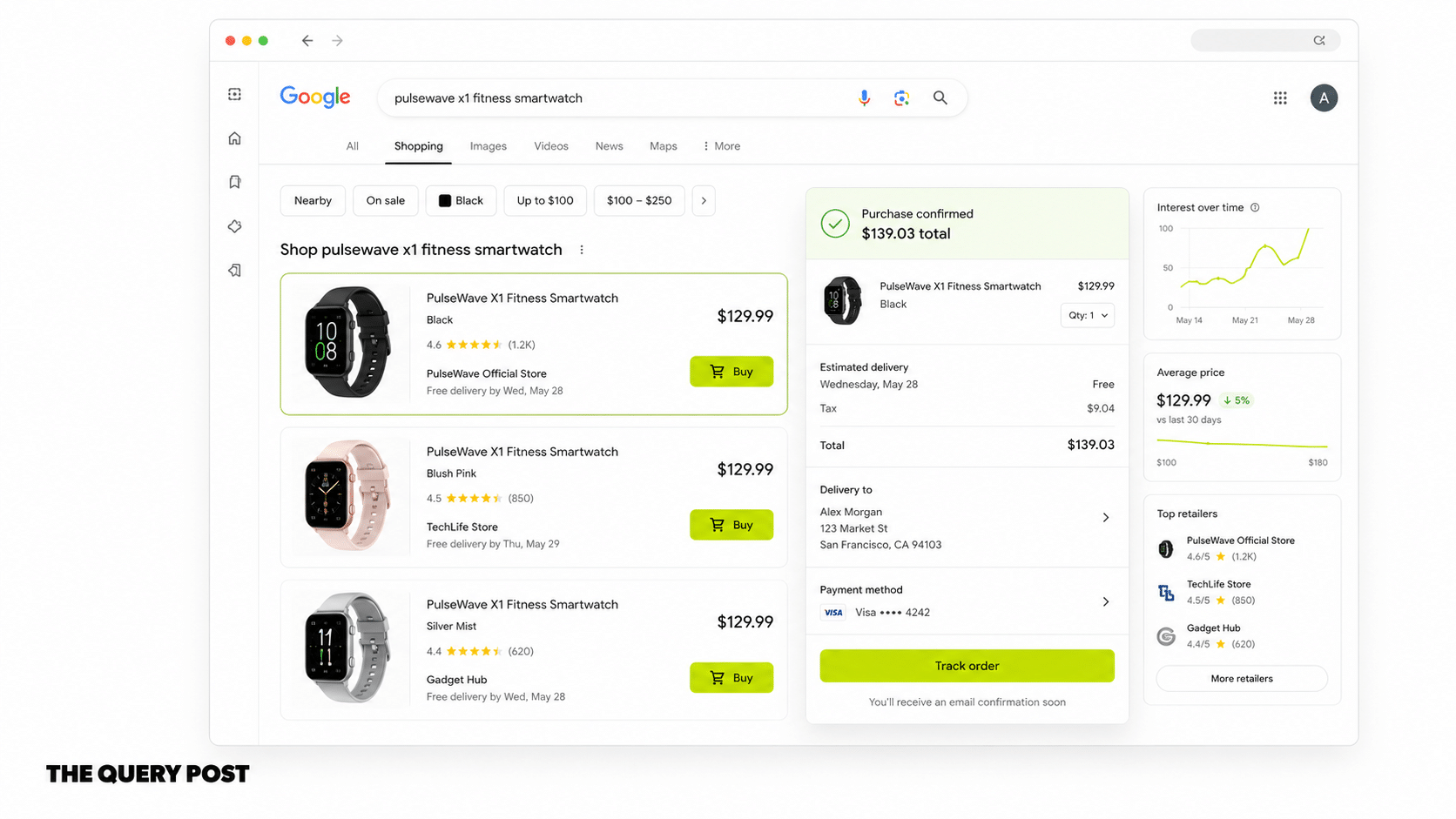
Google appears to be taking another serious step toward native commerce inside Search. A new Buy button has been spotted directly in Google Search product listings, allowing users to begin checkout without leaving the search results page.
The feature is powered by Google’s Universal Commerce Protocol, or UCP, a new standard designed for agentic commerce. In simple terms, UCP gives Google, retailers, payment providers and AI agents a shared way to handle product discovery, checkout and post-purchase interactions.
For anyone who remembers Buy on Google, this may sound familiar. Google already tried native checkout before. That program was discontinued in September 2023. But this new version is different. UCP is not just another Shopping feature. It is being built for a future where AI systems help users research, compare and complete purchases inside Google’s own surfaces.
From Buy on Google to UCP
Buy on Google allowed shoppers to purchase products through Google instead of visiting a retailer’s website. The idea never became a major force in e-commerce and Google eventually shut it down.
Now the concept is returning in a more ambitious form. UCP is designed to work across Google Search, AI Mode, Gemini, Google Pay and merchant systems. Instead of simply adding checkout to Shopping results, Google is building a commerce layer that can support AI-driven shopping journeys.
That distinction matters. The old Buy on Google model was mostly about convenience. UCP is about infrastructure.
The Buy Button Is Moving Beyond AI Experiments
Google has already announced UCP-powered checkout for AI Mode in Search and the Gemini app. In those environments, eligible users can see a Buy button on supported product listings and complete the purchase using saved payment and shipping details through Google Pay.
The more interesting development is that the same type of Buy button has now reportedly appeared in regular Google Search product listings. Semrush reported that UCP-powered checkout was spotted in the main SERP, specifically on Wayfair product listings. That does not yet mean a broad rollout across all retailers or all users, but it shows the direction clearly: native checkout is no longer limited to experimental AI surfaces.
If Google brings this experience deeper into the classic search results page, the impact could be significant. Search would no longer only send traffic to online shops. It could become the place where the transaction itself begins and ends.
The Merchant Still Remains the Seller
One important detail is that Google is not positioning UCP exactly like a traditional marketplace. According to Google’s documentation and related UCP explanations, the merchant remains the seller or merchant of record. Google provides the checkout surface and payment flow, but the transaction still formally belongs to the retailer.
That makes the model different from Amazon. Google does not need to become the retailer. It can stay the interface, the discovery layer and the payment bridge while merchants continue to handle the actual sale, fulfillment and customer relationship.
For retailers, that may make UCP easier to accept than a full marketplace model. For Google, it creates a way to keep users inside its ecosystem for longer without fully replacing merchants.
Why Google Merchant Center Becomes Even More Important
UCP is closely connected to Google Merchant Center. Retailers do not need to start from zero if they already maintain product feeds in Merchant Center, but they will need to meet the requirements for native checkout eligibility.
A key part of this setup is the native_commerce product attribute. This tells Google which products can be made eligible for UCP-powered checkout. In practice, this makes feed quality even more important than before.
Clean product titles, accurate prices, availability, variants, shipping details, return policies, product identifiers and structured merchant information are no longer just Shopping Ads hygiene. They become part of whether a product can be understood, trusted and selected inside AI-driven shopping flows.
What This Means for SEO and GEO
For SEO and GEO, this is not just an e-commerce feature. It is another sign that search visibility is moving away from simple blue links and toward structured, transactional experiences.
If AI systems are going to compare products, recommend options and trigger checkout flows, they need clean data. That means product feeds, schema, merchant information and brand trust become core visibility signals. A product page alone may not be enough if Google’s shopping systems cannot reliably understand the offer.
This also changes the role of the website. In some cases, the website may become less of the first user touchpoint and more of a data, trust and validation layer behind Google’s own shopping interface.
For e-commerce brands, the practical takeaway is clear: Merchant Center should no longer be treated as a secondary channel. It is becoming a central part of search visibility, AI visibility and conversion infrastructure.
Why This Could Be a Bigger Deal Than Buy on Google
The timing is what makes UCP different. When Buy on Google existed, users were still mostly shopping through traditional search results, product pages and marketplaces. Today, Google is trying to connect shopping with AI Mode, Gemini and agentic commerce.
That gives the Buy button a much larger strategic role. It is not just about saving a click. It is about training users to complete purchases inside Google-controlled environments.
If this becomes widely available, price comparison sites, affiliate publishers, shopping aggregators and even some direct-to-consumer brands could feel the pressure. The more Google handles the research and transaction layer itself, the harder it becomes for intermediaries to capture the user before the purchase happens.
The Bottom Line
Google has not simply revived Buy on Google under a new name. UCP looks like a broader attempt to build commerce directly into the next generation of Search.
The rollout is still limited, and the appearance of UCP-powered checkout in regular search results should be treated as an early signal rather than a finished global launch. But the direction is hard to ignore.
Google wants Search to do more than answer questions and send users elsewhere. It wants Search, Gemini and AI Mode to help users decide what to buy and complete the purchase inside Google’s ecosystem.
For retailers, SEOs and GEO teams, the message is simple: product data is becoming search strategy. The brands that maintain clean feeds, strong structured data and trusted merchant information will be better positioned for the next version of Google Shopping, where visibility and checkout may happen in the same place.
Sources
- Semrush: Google’s Universal Commerce Protocol capabilities expand to main SERP
- Google Shopping Help: Buy on Google is no longer available
- Google for Developers: Buy on Google has been deprecated
- Universal Commerce Protocol: How UCP powers checkout inside Google AI Mode and Gemini
- The Verge: Google brings buy buttons to Gemini and AI Search
- Axios: Google, Shopify and retailers push AI shopping standard
