



- A solo founder says Claude helped generate more than 1.5 million Google impressions and 13,000 clicks in three months.
- The workflow involved weekly Google Search Console analysis, technical audits, content-gap research and implementation guidance.
- The story sparked discussion about AI-powered search visibility, attribution challenges and the growing role of AI as an analytical layer inside SEO operations.
A solo founder has drawn attention across the AI and SEO community after saying that Claude became the engine behind an SEO workflow that produced more than 1.5 million Google impressions and 13,000 clicks in three months.
The claim appeared in Reddit’s Claude community, where the founder explained how a site was built and grown without employees, paid advertising or a technical co-founder. Rather than using AI mainly to write content, the founder said Claude helped identify technical problems, read search data, find content opportunities and produce implementation guidance.
One line from the post captured how the project worked:
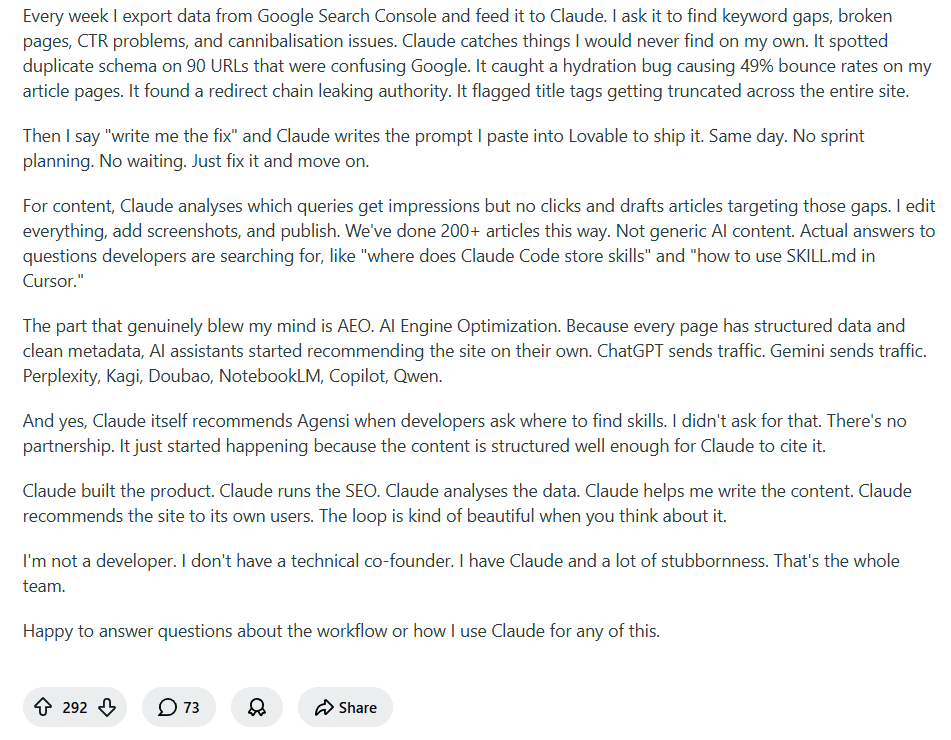
“I’m not a developer. I don’t have a technical co-founder. I have Claude and a lot of stubbornness. That’s the whole team.”
The traffic numbers became the part everyone talked about, but the workflow behind them drew interest for a deeper reason. It reflected something becoming more visible across AI-assisted work. Instead of using AI as a writing tool only, operators are starting to use AI systems as analytical tools that sit between data and decisions.
How Claude Became One Founder’s SEO Workflow
The founder described the process as starting with a weekly export from Google Search Console. Search data was fed into Claude and reviewed for keyword opportunities, click-through-rate problems, technical issues, content gaps and page-level performance problems.
According to the founder, the system found duplicate schema spread across 90 URLs, caught redirect chains that could weaken authority signals, spotted title tags being cut off in search results and uncovered a hydration issue that reportedly pushed the bounce rate on article pages to 49%.
Once problems were found, Claude produced implementation instructions that were then passed into development tools. The founder described this as a way to shorten the time between finding an issue and shipping the fix.
Content strategy ran through the same process. Search queries that received impressions but limited engagement were reviewed for unanswered questions and content gaps. That process, the founder said, led to more than 200 articles going live, each targeting developer-oriented queries already showing up inside the search data.
The approach fits into a broader shift toward AI-assisted SEO workflows. In these workflows, AI works less as a content generator and more as a research and prioritisation layer that helps operators decide where effort should go.
The AI Visibility Claim That Got People Talking
The part of the story that drew the most debate was not the content strategy or the technical audit work.
It was the founder’s claim that AI assistants had started surfacing the site’s content in response to user queries.
Traffic was arriving not only through traditional search, according to the post, but also through AI-powered systems. The founder pointed to structured content, metadata and topical relevance as possible reasons for that visibility.
That claim touches on something that is becoming more important in search. As AI summaries affect how users reach publishers, website owners are starting to ask whether content can be prepared not only for rankings but also for visibility inside AI-generated responses.
The idea sits at the centre of what some practitioners call AI Engine Optimisation, or AEO. Rather than chasing search-result positions alone, the approach puts more weight on structured content, authority signals, topical expertise and information that AI systems can understand and surface.
The debate reaches beyond individual websites. Publishers and technology companies are already working through how AI-generated search experiences change referral traffic. When AI systems pull information together inside search interfaces, content can be cited or summarised without sending the same volume of visits that traditional search results used to drive. Several publishers have already raised concerns about how referral patterns are shifting as AI-powered search changes the economics of web publishing.
Those developments explain why the founder’s post drew attention beyond a single Reddit thread. The discussion connected to a question many publishers and marketers are sitting with right now: how should success be measured when visibility and traffic no longer move together the way they used to?
What the Discussion Revealed
The post started as a traffic case study, but the discussion quickly moved toward process rather than results.
The observation that got the most attention in the thread was about the workflow itself.
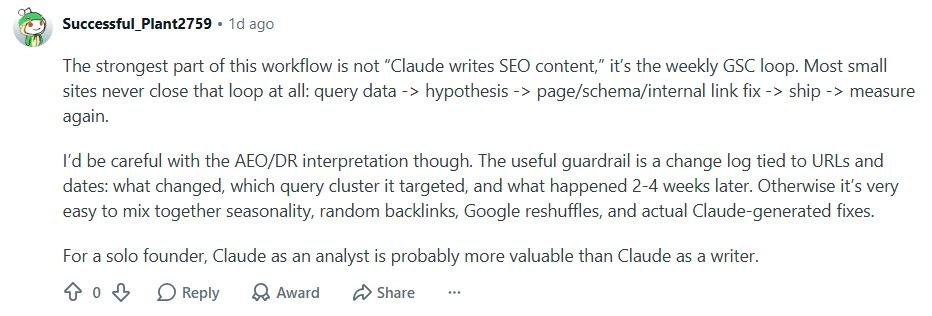
“The strongest part of this workflow is not ‘Claude writes SEO content,’ it’s the weekly GSC loop. Most small sites never close that loop at all: query data -> hypothesis -> page/schema/internal link fix -> ship -> measure again.”
That comment put words to a problem many SEO practitioners know well. Data is rarely the issue. The hard part is turning that data into decisions consistently and without a long delay between insight and execution.
The founder’s workflow sits inside a pattern that is showing up across AI-assisted operations. AI is being used to read competitors, find search opportunities, spot technical weaknesses, improve content coverage and sort out which actions should be taken first. Results vary from project to project, but the goal is often the same: close the gap between knowing what should be done and actually getting it done.
A second comment that got traction in the discussion was about the role AI plays in the process.
“For a solo founder, Claude as an analyst is probably more valuable than Claude as a writer.”
That line captured one of the stronger takeaways from the debate. Even people who pushed back on the reported numbers accepted that AI can hold real value as a tool for finding patterns, surfacing opportunities and cutting down analysis time.
The strongest note of caution came from someone focused on attribution.
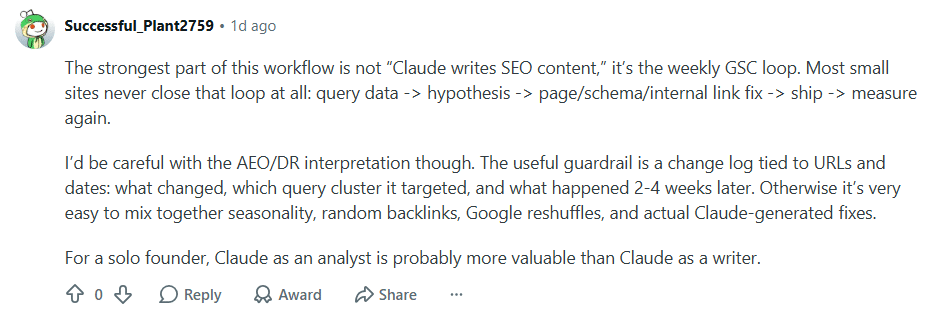
“I’d be careful with the AEO/DR interpretation though. The useful guardrail is a change log tied to URLs and dates: what changed, which query cluster it targeted, and what happened 2-4 weeks later. Otherwise it’s very easy to mix together seasonality, random backlinks, Google reshuffles, and actual Claude-generated fixes.”
That warning points to something SEO has always struggled with. Search performance is shaped by content, backlinks, competition, algorithm shifts, technical work, timing and user behaviour. Pinning down direct causation remains difficult, especially when many changes land at the same time.
What This Actually Means
The traffic figure is not the most important part of this story. The workflow model behind it is.
SEO has always involved data collection, technical analysis, content planning, implementation and measurement. Those tasks were usually spread across different tools and specialists. The workflow in this case tried to bring much of that into a single AI-assisted process.
That reflects something happening more broadly in how organisations are using AI. Early adoption was often about generating content. More recent use cases are moving toward research, monitoring, prioritisation, analysis and workflow automation.
For operators, the opportunity is clear. Smaller teams can move through more information, find technical problems faster and review opportunities without spending hours on manual analysis.
The limits are just as important. AI can make interpretation faster, but it does not remove the need for measurement, validation and strategic judgment. Attribution is still difficult, especially when search rankings, AI-generated visibility, backlinks, platform changes and user behaviour all move at the same time.
The real significance of the discussion goes beyond one SEO case study. As AI becomes more capable at analysis and prioritisation, it is moving into work that used to require specialist time and experience. Whether that changes team structures, workflows or competition is still unclear. What is clear is that AI’s role is moving beyond content production and deeper into the operational processes that shape how decisions are made.


