


- Websites with great search engine rankings don’t always make an appearance when you ask ChatGPT, Perplexity, or Gemini for info.
- And to be honest, there’s no widely accepted way of measuring the impact that these AI tools have yet so what folks are trying is citations, seeing how often certain prompts are used, and checking out where the referrals are coming from.
- Initial results and we’re talking super early days here suggest that these AI systems are leaning towards valuing how well a piece of content is laid out, how up-to-date it is, and the number of citations it’s got over other traditional factors that search engines have relied on.
The numbers looked fine. Rankings held steady. Traffic moved as expected, and SEO dashboards showed nothing worth worrying about. Then marketers started running the same queries across Google, ChatGPT, Perplexity, and Gemini. What came back was often completely different.
What started as a few quiet observations has now grown into a wider industry conversation. Marketers are asking whether search rankings alone can still explain how people find information online.
A Gap That Was Never Being Watched
It started with a simple question about GEO, or Generative Engine Optimisation, tools. Things moved quickly from there. Marketers described sites doing well on Google but barely appearing in AI-generated answers. Others saw the opposite smaller publishers showing up often in ChatGPT and Perplexity, without the authority signals that normally drive search performance.
Nothing looked broken inside traditional SEO reporting. That was exactly the problem.
Rankings stayed the same. Traffic stayed the same. The gap only became clear when marketers searched the same query across platforms and compared results directly. The timing matters. Data from the UK’s Office for National Statistics shows that in late 2025 a surprisingly high 25% of businesses were already getting in on the AI trend, with another 15% planning to follow suit within the next three months. Back in 2023, AI adoption was a pretty modest 9% but that was just the start of it, with projections suggesting that by 2024 that number would have risen to 22%.
As AI starts to play a bigger role in how people get information, marketers are beginning to wonder whether traditional search numbers are giving them the whole picture.
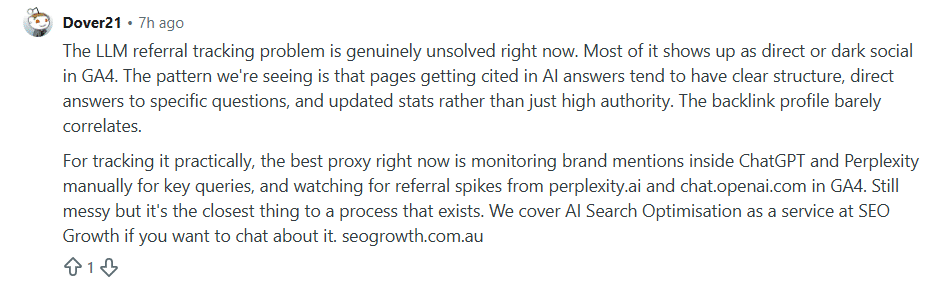
“The backlink profile barely correlates.”
That one line became one of the most talked-about comments in the whole conversation. People kept pointing to pages getting AI citations despite having modest backlink profiles. The same things kept coming up, structure, direct answers, updated content, and supporting citations.
Nobody claimed to have found the formula. What grew instead was a quiet, unsettling suspicion that AI systems may judge usefulness in ways that traditional search engines simply do not.
Finding Answers Is Getting Complicated
Once marketers accepted that a visibility gap might exist, another problem appeared. Nobody knew how to measure it properly. Traditional SEO platforms still matter. Semrush and Ahrefs are often important for keyword tracking, competitor research, and content planning. Several marketers were clear that those tools still play a central role.
But many argued that those platforms no longer answer every question. Some looked to Similarweb for referral patterns and audience movement. Others pointed to newer platforms such as Geoptie, Rankability, and Frizerlly, which focus on AI visibility and citation tracking.
The real discussion, though, was never about tools.
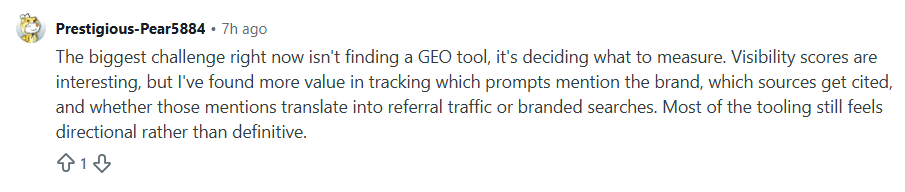
“The biggest challenge right now isn’t finding a GEO tool, it’s deciding what to measure.”
That line landed hard because it named something everyone was feeling but not saying out loud. Should brands count citations? Track prompt mentions? Watch referral traffic? Monitor branded search demand? Measure conversions? Visibility scores alone did not convince many people. Several argued that measuring AI visibility without linking it to business impact risks building another layer of reporting that looks useful but explains very little.
The pressure is growing. ONS research found that among businesses planning to adopt AI, 69% wanted to upgrade processes and methods, while 42% expected AI to automate tasks previously performed by labour. AI is moving fast. The industry’s way of measuring it is not keeping up.
What Happens When Rankings Stop Explaining Visibility?
The discussion moved on, and attention began to shift not toward software, but toward content. Participants kept saying AI-generated answers gave preference to pages that answered questions in a direct way, cited sources without confusion, and kept information current. Freshness came up again and again. Structure followed the same pattern. Clarity did too.
One marketer put the shift into words that matched what others in the room were already feeling.

“the structure and recency angle is way more predictive than domain authority at this point, which is honestly wild to watch play out. might be worth treating AI visibility like a completely separate content strategy instead of trying to retrofit it into normal SEO.”
Not everyone agreed with this view. But it came up enough to reveal a bigger question forming across the industry. If AI-generated discovery rewards different signals than traditional search, should marketers treat AI visibility as part of SEO or as its own thing entirely? The conversation never gave a clear answer. What it gave was proof that more practitioners are now asking this very question.
Notable Reactions Across the Industry
Several marketers were clear that traditional SEO is not going away. One commenter noted that Semrush and Ahrefs still matter for keyword tracking, but argued that AI visibility needs more layers of analysis on top of that. Others pointed to referral attribution as one of the biggest blind spots the industry has right now. Traffic coming from AI platforms often shows up as direct traffic or becomes hard to sort inside analytics tools, which makes it difficult to understand what AI-driven discovery is really doing.
There was also wide agreement that citations, mentions, and real business outcomes will matter more than visibility scores that stand on their own. Together, the discussion painted a picture of an industry still in the middle of experimenting, not one that has found solid ground.
Expert Opinion
The most important thing to take away is not that GEO tools are emerging. It is the growing understanding that visibility and rankings may no longer mean the same thing. For years, marketers could assume that strong rankings meant strong visibility. AI-generated search experiences now place something new between content and discovery something that appears to reward qualities that traditional SEO reporting does not always pick up.
The opportunity is there for anyone to see. Publishers on the smaller side and niche experts may be able to earn visibility inside AI-generated answers without having to compete on authority and scale alone. The risks are just as clear to see. Attribution stays inconsistent. Measurement stays scattered. Visibility standards remain undefined.
Research from the ONS has found that firms with stronger management practices are more likely to adopt AI technologies and follow through on those plans. The same pattern is appearing in what marketers are watching in AI search execution quality, structure, and clarity are beginning to matter as much as size does.
The discussion did not settle anything. What it did was show an industry starting to sense that the rules around online discovery are changing faster than the tools built to measure them.


