



- Google says AI Mode and AI Overviews rely on the same core ranking and quality systems as classic Search, challenging the idea that brands need a separate “GEO” playbook specifically for Google.
- That does not settle the wider AI-search question: ChatGPT, Claude, Perplexity, Copilot and other answer engines may discover, rank, summarize and cite sources differently.
Marketers spent the last two years inventing new names for search work. GEO. AEO. LLM SEO. AI visibility. Each label arrived with its own consultants, tools, conference slides and budget line.
Google’s latest message to CMOs is much simpler: do not treat AI search on Google as a separate ranking universe.
Google’s Position: Good SEO Is Still the Base Layer
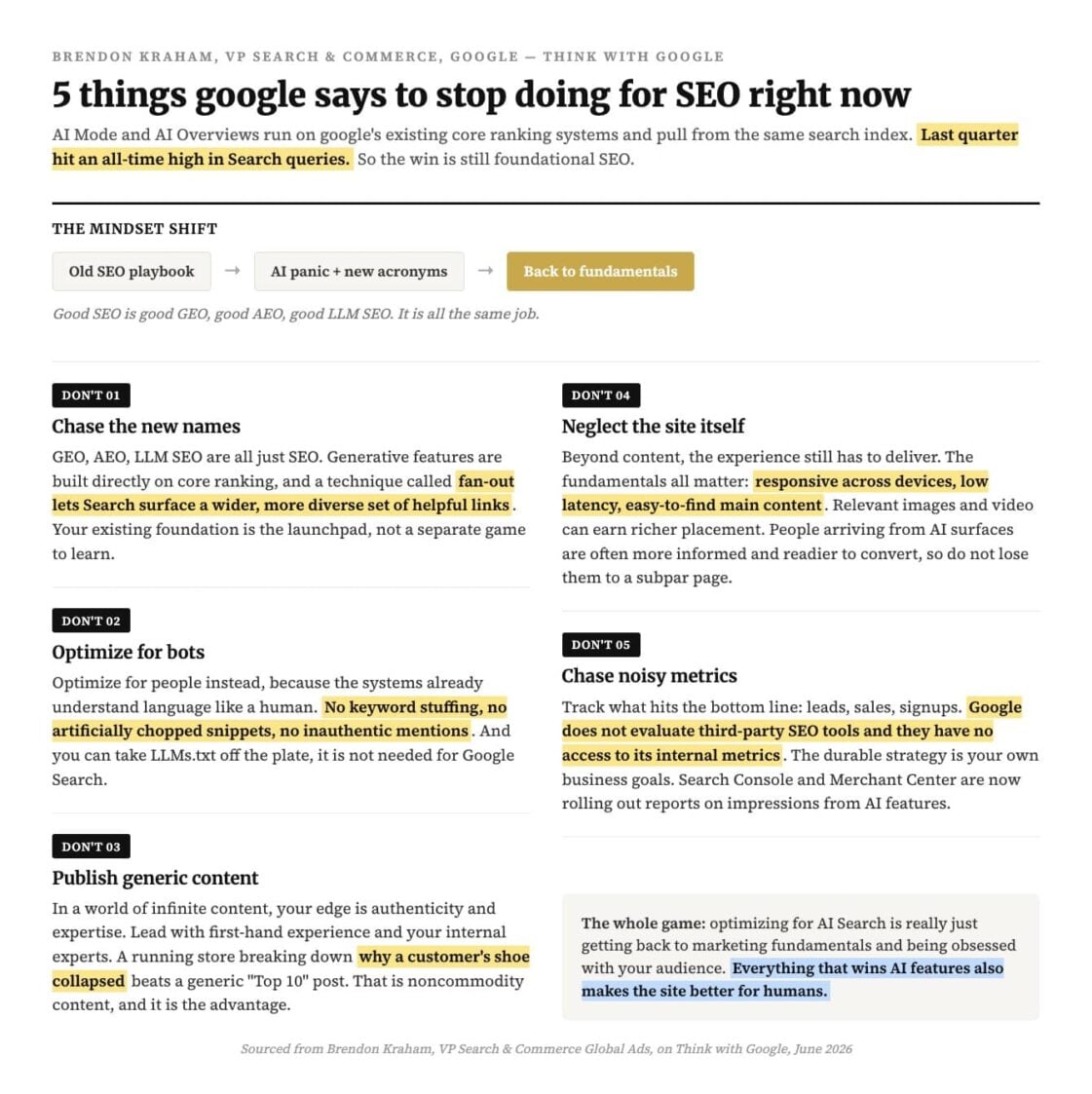
Brendon Kraham, Google’s VP of Search and Commerce for Global Ads Solutions, laid out the position in a June 2026 piece on Think with Google. AI Mode and AI Overviews, he wrote, are rooted in the same core ranking and quality systems as traditional Search.
Google makes the same point in its Search Central guide to optimizing for generative AI features. The company says AI features on Google Search rely on techniques such as retrieval-augmented generation and query fan-out, but still draw from Google’s Search index and core ranking systems.
That distinction matters. Google is not saying AI search has no new presentation layer. It is saying brands should not assume there is a second Google ranking machine with a separate set of tricks.
The practical advice remains familiar: create useful, non-commodity content, make pages crawlable, structure information clearly, support content with relevant images or video where it helps users, and build a web experience that does not fall apart once a visitor arrives.
The Important Limit: Google Can Only Speak for Google
There is a limit to Google’s argument that marketers should not ignore.
Google can speak for Google Search, AI Mode and AI Overviews. It cannot speak for ChatGPT, Claude, Perplexity, Copilot or other answer engines that may retrieve, rank, summarize or cite sources in different ways.
That makes the strongest reading narrower than “GEO is dead.” For Google Search, AI visibility still sits on top of classic search systems. Across the wider AI-search market, brands may still need to understand how different answer engines discover sources, represent entities and choose citations.
The mistake is treating that work as a secret replacement for SEO. A more useful framing is platform-specific visibility research built around search fundamentals.
What Google Is Telling Brands to Stop Buying
Kraham’s piece reads less like a new strategy guide and more like a warning against weak add-ons.
He tells brands not to write awkward copy for bots, not to chase inauthentic mentions across forums and blogs, and not to rely on AI-specific files such as llms.txt as a shortcut for visibility in Google Search.
That last point is especially relevant because llms.txt has become one of the easiest things for vendors to sell. It is simple, visible and technical enough to become a deliverable. But Google’s position is that, at least for Google Search, it is not needed.
This fits with Google’s wider messaging around AI-facing technical files, a topic The Query Post covered previously in its reporting on Google’s messy llms.txt messaging.
Google also says third-party SEO tools and vendors do not have access to its internal metrics. That does not make third-party tools useless. It does weaken any pitch that claims proprietary visibility into hidden Google AI ranking mechanics.
Same Systems Does Not Mean Same Output
The strongest version of the story is not “GEO is fake.” That would be too simple.
Google’s claim is about the underlying systems. Independent research is increasingly focused on the visible outputs: which sources appear, how often AI Overviews trigger, how citations differ from classic rankings, and what happens to publisher traffic when answers are summarized before the click.
A May 2026 paper titled “Measuring Google AI Overviews: Activation, Source Quality, Claim Fidelity, and Publisher Impact” analyzed 55,393 trending queries across 19 topical categories. The authors found that AI Overviews appeared for 13.7% of queries overall and 64.7% of question-form queries. They also found that nearly 30% of cited domains did not appear in the co-displayed first-page results.
Another 2026 study, “How Generative AI Disrupts Search”, compared Google Search, Google AI Overviews and Gemini Flash 2.5 across 11,500 queries. It reported low source overlap between systems, with less than 0.2 average Jaccard similarity, and found that AI Overviews were less consistent when the same query was repeated or slightly edited.
Those findings do not prove that Google has a completely separate ranking system for AI search. They do show why marketers are not imagining the measurement problem. AI search may be built on Search, but the answers users see can still produce different visibility outcomes.
Why Measurement Still Matters
Google’s own product direction supports that point.
On June 3, 2026, Google announced Search Generative AI performance reports in Search Console, including dedicated views for impressions in AI Overviews, AI Mode and generative AI features in Discover.
That announcement undercuts the weakest vendor pitches, but not the entire category. If AI visibility were irrelevant, Google would not need separate reporting for it.
The difference is between measurement and mysticism.
A tool that tracks where a brand appears in AI-generated answers, which competitors are cited, which pages surface and where coverage is missing can be useful. A tool that promises to optimize for a secret “AI ranking factor” separate from Search should face a much harder procurement conversation.
The Traffic Question Is Separate From the Ranking Question
There is also a publisher-side issue that Google’s “good SEO is good GEO” framing does not fully answer.
A 2026 paper on Google AI Overviews and Wikipedia traffic estimated that exposure to AI Overviews reduced daily traffic to exposed English Wikipedia articles by about 15%. The study focused on Wikipedia, not commercial sites, but it points to the broader concern: even when a site is visible, an AI summary may satisfy enough of the query that fewer users click through.
That means marketers need to separate three questions that often get collapsed into one:
- Can Google discover, index and understand the content?
- Can the brand or page appear inside AI-generated answers?
- Does that visibility produce clicks, leads, sales or other business outcomes?
The first question is classic SEO. The second is visibility measurement. The third is business performance. Calling all three “GEO” makes the conversation less precise, not more.
What Marketers Should Ask Vendors Now
The practical impact lands on procurement conversations.
If a vendor sells AI-search work, the first question should be simple: which existing search fundamental does this improve?
If the answer is better crawlability, clearer information architecture, stronger first-hand content, cleaner product data, improved entity consistency, better media support, stronger authority signals or more useful visibility reporting, the work may be worth discussing.
If the answer depends on bot-targeted rewrites, artificial mentions, llms.txt as a Google visibility hack, or access to a hidden Google AI ranking system, Google’s latest guidance gives marketing teams a reason to pause.
For non-Google answer engines, the question should be slightly different: what evidence shows that this platform discovers, cites or represents brands differently, and how can that be measured without inventing unverifiable ranking myths?
Practical Takeaway
For Google Search, AI visibility should be treated as an extension of SEO, not a replacement for it.
Brands still need strong content, crawlable pages, clear structure, authority, useful media, product and local data where relevant, and a site experience that satisfies visitors. They may also need better reporting to understand how AI Overviews and AI Mode change visibility.
For ChatGPT, Claude, Perplexity and other AI answer engines, the work may require separate visibility research. But that does not make every GEO pitch valid. The useful version measures where a brand appears and improves the underlying content, entity and authority signals. The weak version sells a secret ranking system nobody can verify.
The safer budget question is not “Do we need GEO?” It is: what specific visibility problem is this work solving, and can the result be checked?


