


The feature that sparked all of this wasn’t some headline-grabbing Instagram launch. Most users couldn’t even find it. A Reddit thread about a simple profile setting quietly grew into something bigger, pulling marketers into a conversation about how Instagram decides what gets seen, who gets found, and whether the optimization advice they’d followed for years had already gone stale.
Inside the Instagram Marketing community, marketers started comparing notes, and what came up felt like more than routine platform gossip. The original post made a pointed case: Meta AI may now be playing a much larger role in Instagram discovery, reshaping how accounts are categorised and how content finds its way in front of people. Within hours, users were testing the claims themselves, digging through profile settings, and dropping their own findings into the thread.
The thread caught on because the timing was hard to ignore. Through 2026, Instagram has kept moving, expanding tools for creators, pouring resources into Reels, testing new discovery mechanics, and finding fresh ways for users to engage with content. Set against all of that, the idea that AI was quietly changing the rules of search didn’t sound outlandish to marketers who had been watching the platform shift in real time.
But the feature itself was almost beside the point. What made the thread worth reading was what sat underneath it: a quiet anxiety spreading across creators, agencies, and small businesses at the same time. If AI is now sitting closer to the door deciding who gets discovered, how much of the old Instagram SEO playbook is still worth anything?
Key Points
- Instagram marketers are debating whether AI-driven discovery is becoming more important inside the platform, with some arguing that keyword stuffing and hashtag-heavy tactics are losing the influence they once had.
- Users in the thread claim Instagram may be leaning harder on profile signals, visual context within content, and the way people phrase searches conversationally to understand and surface accounts.
- The discussion also pulled back a curtain on deeper frustrations: confusion over which features are even available, doubts about whether search results are genuinely relevant, and a growing sense that creators may have less control over their organic reach than they once believed.
A Reddit Thread That Became Something Bigger
It started simply enough: Instagram search may no longer work the way marketers were trained to expect. That was the claim. The post went further, arguing that tactics like packing keywords into profile names or leaning on a wall of hashtags were losing their grip, because Meta AI had moved past simple term matching and was now trying to read context. What creators needed to focus on, the author suggested, wasn’t gaming signals. It was making absolutely clear to the platform what category they belonged to.
That argument steered users toward a feature many had never come across. According to the Reddit post, Instagram lets some users add up to five interests to their profiles, and those interests may help the platform better understand how to categorise accounts and connect them to relevant searches. Clean idea. The problem was that when users went looking for it, many came back empty-handed.
Commenters started asking where exactly to find the option. Some said they had spotted it once, then watched it vanish. Others combed through every corner of their profile settings and found nothing. Even after other users walked them through the steps, several people reported that the feature simply wasn’t there on their accounts. A thread that had opened as a conversation about search had drifted into something else entirely: a discussion about patchy rollouts, uneven access, and whether everyone on Instagram was even using the same platform.
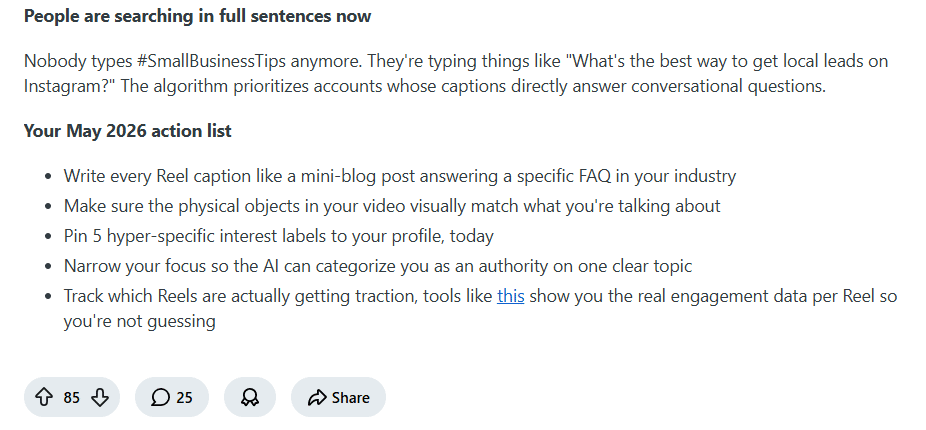
Search behaviour itself became the next focus. The post pointed out that users were no longer typing short labels into the search bar; they were asking full questions. Rather than dropping in a broad topic tag, someone might search: “What’s the best way to get local leads on Instagram?” With that shift in mind, the thread recommended that creators write Reel captions less like throwaway text and more like short blog posts, built around the actual questions their audience was asking.
What the Community Actually Said
Curiosity was the first thing in the room. Scepticism followed close behind. One of the most upvoted comments in the thread made a sharp point: Instagram SEO had always been fragile, and any creator banking their entire growth strategy on a platform that rewrites its own rules every few months was building on sand.

“Instagram SEO was already fragile. Meta changes the algorithm every quarter. If you are building your entire strategy around Instagram, you are one update away from zero traffic. Reddit demand signals stay consistent way longer because people are asking actual questions, not just scrolling for entertainment.”
That comment pulled the thread in a different direction. Profile interests faded into the background; the real concern taking shape was dependency. Relying on systems that no creator controls, systems that can shift without warning or explanation. For many people in the thread, the question wasn’t really about whether Meta AI was reshaping search. It was whether any business could keep up with a platform that never stops changing course.
Relevance came up next, and it wasn’t a gentle observation. One user noted that Instagram’s search results sometimes had little to do with what was actually typed. The reply was short:

“Meta AI giving unrelated content is the real problem.”
That small exchange pointed to something every AI-powered discovery system eventually runs into. Analysing content is one thing. Delivering results that feel genuinely useful, accurate, and worth the user’s time is another thing entirely. One without the other doesn’t work.
What This Actually Tells Us
Whether every claim in that thread holds up under scrutiny is almost secondary. What matters more is what the conversation itself reveals about how marketers now think about being found on the platform. For years, Instagram visibility was treated like a puzzle with known pieces: the right keywords, the right hashtags, a well-tuned profile, a consistent posting schedule. The Reddit thread suggests that framing has started to crack. Many creators no longer feel like they are optimising for a search engine. They feel like they are communicating with an AI that is trying to read their intent, judge their expertise, and understand the context behind what they create.
If that perception is pointing in the right direction, specialists have the most to gain. A creator who holds to a clear subject, shows real products or processes at work, and keeps answering the questions their audience actually asks is giving a recommendation system far more to work with than a creator who jumps between unrelated topics with no consistent thread.
The upside is clear enough: AI-driven discovery, when it works, can pull the right content in front of exactly the right people. The downside is harder to see and possibly more serious. Misclassification, uneven rollouts, shifting recommendation logic, and relevance failures can all quietly drag down a creator’s visibility, with no notification and no obvious explanation.
Instagram’s continued investment in creator tools, video formats, content presentation, and discovery features points in one direction: the platform is working toward a deeper read of what content actually means, not just what it says. The specific theories debated in that Reddit thread may not all prove out. Some already look shaky. But the current running through all of it feels real. Creators are increasingly convinced that being found on Instagram is no longer a technical optimisation problem. It’s a question of whether the algorithm understands who you are, what you make, and why any of it should matter to the people searching for it.


