



When I started working with a local service provider in Edmonton, Canada, he was having trouble with his GBP.
The problem was that he offered a service without a physical storefront or shop. He was a mobile mechanic, so he couldn’t show a physical address on his GBP.
I had to remove the address from his GBP and website to stay compliant with Google’s policies. Many service area businesses don’t know this. Having a physical address listed for an SAB can put the profile at risk.
Service area businesses have some unique challenges. If you go to customers to offer your services, you’re an SAB, and you may need a slightly different approach to local SEO.
In this guide, I’ll walk you through how to stay safe and build a local presence that can generate consistent leads from search.
What Is a Service Area Business?
An SAB is a business that goes to customers rather than serving them at a fixed location, such as an office or a garage.
According to Google, SABs include businesses that operate from a private location, like a home, or that travel to customers to provide services at their location.
Common examples:
- Mobile mechanics
- Plumbers, electricians, and HVAC technicians
- Locksmiths
- Window cleaners and pressure washers
- Tradespeople like painters, builders, and carpenters
- Home services like cleaners, carpet washers, and gardeners
- Field-based installers: fence, CCTV, solar panels, and similar services
Some businesses are hybrids; they have a physical location customers can visit, but they also offer services at the customer’s location. Google treats these slightly differently. For instance, a local florist shop that also delivers flowers to customers. I’ll cover that later in the post.
Why Service Area Businesses Face a Local SEO Disadvantage
Google’s local ranking system weighs three core factors: relevance, distance, and prominence. And service area businesses can only focus on two of them: relevance and prominence.
So, what happens is that since SABs can’t list a physical location, Google can’t precisely calculate the proximity between the business and the searcher.
On the other hand, storefront businesses have a public address, which makes the calculation more precise. Proximity is one of the strongest local SEO ranking factors.
However, that doesn’t mean SABs can’t rank well. It just means they have to compensate by making the other factors work harder.
This includes having a:
- Well-optimized GBP
- Review-generation strategy
- Solid website with location pages
- Consistent business information across the web
The good thing is that when you’re competing with other SABs, there’s a level playing field, and the one who does the basics right will win in the long run.
How to Set Up Your Google Business Profile as a Service Area Business
This is the most important first step for any service area business. If you do it right, you can still show up in the Google Local Pack without displaying an address. Done wrong, it can lead to profile suspension.
Hide Your Address
When you’re setting up or claiming your GBP, Google asks you whether you serve customers at your address or travel to them. Choose the right option here.
You’ll still need to enter an address at this stage. Google uses this address for verification. You should then mark it as hidden so that it doesn’t appear publicly. Customers will then only see the service areas you serve.
Don’t use a virtual office address or a co-working space address you don’t actually operate from. This violates Google’s policies and can lead to a suspension. If you operate from home, that’s the address Google needs.
Set Your Service Areas Strategically
Google lets you add up to 20 service areas. You might be tempted to cover as many areas as possible, but don’t list too many of them. Listing only a few specific ones tends to work better.
List the cities, neighborhoods, postcodes, or counties you actually serve. Listing an entire state when you don’t serve it fully is unlikely to help your rankings.
For the mobile mechanic client, we listed the ones he serves around Edmonton, Canada. You want to keep it realistic.

Choose the Right Primary Category
This may be the single most important decision you can make for your GBP. Your primary category must match what you actually do as precisely as possible.
For someone who travels to customers, for instance, “Mechanic” is a more suitable category than “Auto Repair Shop”.
This helps Google put you in front of the right people when they look for businesses like yours.
Build Out Your Website With Service and Location Pages
As we already know, the physical address is a strong local anchor. And you can’t display that on your GBP as an SAB.
So, your website becomes an even more valuable asset. It’s where Google looks to verify what you do and where you offer your services.
Create Individual Service Pages
A “Services” page is a nice-to-have, but you also need a dedicated page for each service if you’re offering multiple services.
Each service page should target a specific local keyword. For instance, the Houston-based client I work with offers multiple services. Here’s one of their service variations:
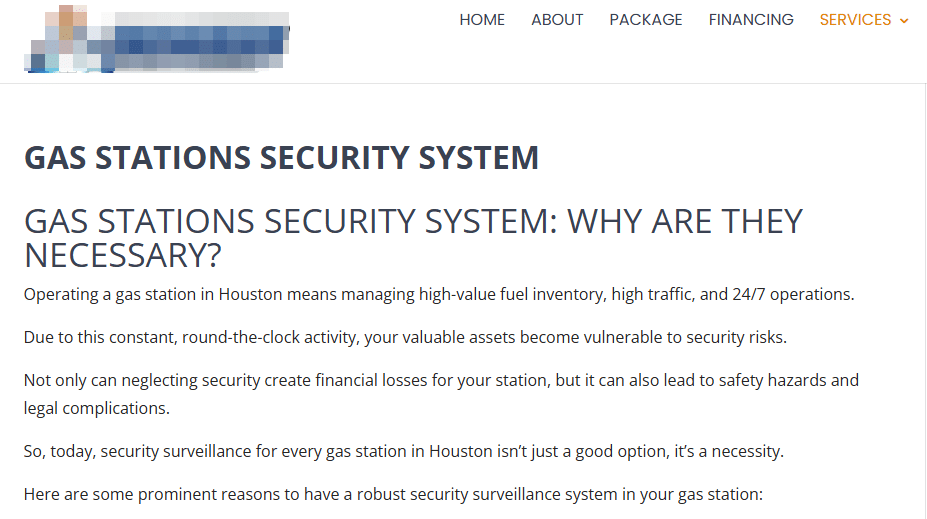
In this case, I created their pages based on the industry they serve, another angle you can consider for your business.
Every service needs a separate page, although I think they should also have a parent “Services” page. This way, you’re creating a stronger internal linking structure on your website.
Build Location Pages for Each Area You Serve
This can be even more important for service area businesses. After all, your entire business depends on serving people at their location.
Here’s the simple action plan: build dedicated location pages for each area you serve. These location pages help you rank for location-specific queries. A generic homepage can’t do that.
Something to keep in mind: never copy-paste the same content on multiple pages, even if they serve a similar purpose.
For instance, you might be tempted to share the exact “CCTV installation” page for “Houston” and “Katy, Texas”. The service might be the same; the location isn’t. And more importantly, duplicate content isn’t a good thing for your site’s SEO and authority.
Reviews Matter Even More for Service Area Businesses
Reviews matter for every local business, but with proximity working against you, prominence is where you compensate. You can use customer reviews to build prominence.
I covered this in more depth in the How to Get More Google Reviews guide. For consistent review generation, you want to build the review request into your workflow.
Send a follow-up message right after you complete a job with a direct link to your GBP reviews page. And send it while the experience is still fresh, ideally 24 to 48 hours after job completion.
Last but not least, don’t leave any review unanswered. Start by going back and answering past reviews on your profile, even if they’re negative.

Build Citations and Keep NAP Consistent
Your business name and phone number become even more important without a physical address. They’re the two public details Google can use to verify your business across the web.
Get your NAP right on every directory that lists your business. I said NAP because many directories will still request your address. In those cases, use the address you provided Google during verification.
The rule remains the same for every local business: consistency reinforces your legitimacy.
Focus on the core platforms first: Google, Bing Places, Apple Maps, Yelp, and any industry-specific directories relevant to your service. A small number of accurate, consistent local citations does more than a large number of inconsistent ones.
Use GBP Features That Reinforce Service Area Signals
Add Photos From Real Jobs
Photos of real work in real locations show that you actually go to where you claim. This builds credibility in a way stock images never can.
Also, you want to name your photo files descriptively.
- Good: “Mobile-mechanic-engine-repair-birmingham.jpg”
- Bad: “IMG_4833.jpg”
Post Updates Consistently
Sharing posts through your GBP is a simple way to show that your profile is active.
For a service area local business, posts about recent jobs, areas you’re working in this week, or seasonal services can help reinforce activity and geographic relevance.
Stay consistent. Even one post per week is fine.
List Your Services in Detail
Don’t neglect the services section on your GBP. It lets you list every service individually with a short description.
For an SAB, this is a strong place to reinforce what you offer and the language your customers use to search for it.
Each service should have its own clear name and a short description.
Hybrid Businesses: When You Have a Physical Location and Travel
Some businesses do both: operate from a public location and travel to customers.
For instance, a bakery that also offers delivery. Or a vet clinic with mobile services.
Hybrid businesses can show their address. After all, it’s actually a location customers can visit. Plus, they should specify their service areas.
This gives them the proximity benefit of a storefront business and the broader service-area coverage of an SAB.
If you’re a hybrid, make sure your website and GBP make both clear. Customers should easily understand whether they’re expected to come to you or you’ll come to them.
What Service Area Businesses Should Take From This
Service area businesses might be at a structural disadvantage in local search. One of the factors Google leans on is proximity; it’s exactly what an SAB can’t pinpoint as clearly as a storefront can.
But it’s not a dealbreaker, especially when an SAB is competing with other SABs. You can rank at the top with a slight tweak in your local SEO strategy. But the basics remain the same.
A tightly optimized GBP, focused service areas, strong reviews, accurate citations, and a website that does the heavy lifting your storefront would otherwise do.
Our take: It’s easy for an SAB to underestimate how possible it is to outrank competitors in local search. The work is not flashy. It is doing the fundamentals well, consistently. That is often enough to beat competitors who set up their GBP once and then ignore it.


