



- The strongest digital marketing “hacks” being shared right now are not shortcuts. They are better ways to find real customer demand before competitors do.
- Marketers are using Search Console queries, Reddit threads, reviews, sales calls and support requests as research sources instead of relying only on keyword tools.
- AI search is making clear, answer-ready content more important, but it is also exposing weak content libraries that were built for volume instead of usefulness.
The Best Marketing Hacks Are Starting to Look Less Like Hacks
The question sounded like it would produce the usual answers.
Someone asked marketers to share the craziest digital marketing hack that had recently produced real results.

“What is the craziest digital marketing hack that actually gave you real results recently?”
The surprising part was how few of the better answers sounded like hacks.
The useful examples were not about gaming a platform, finding a loophole or chasing a new tool trick. They were about getting closer to real demand: Search Console queries, Reddit discussions, customer questions, review language, sales conversations and old pages that already had proof of interest.
That is the actual story.
Digital marketing is not running out of tactics. It is running out of tolerance for tactics that are disconnected from what customers are already asking, comparing and trying to solve.
Search Console Is Becoming a Demand Research Tool
One of the clearest patterns was how often Google Search Console came up, not as a reporting dashboard, but as a research source.
Marketers were using it to find the exact questions and long-tail searches that already bring people toward a product or service. That is different from starting with a keyword tool and guessing which topics might matter.
One comment summed it up well:
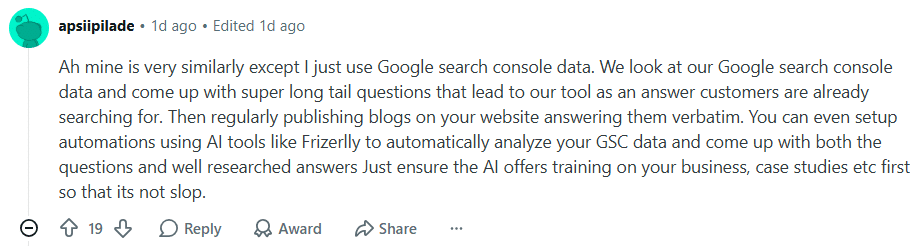
“We look at our Google Search Console data and come up with super long tail questions that lead to our tool as an answer customers are already searching for. Then regularly publishing blogs on your website answering them verbatim.”
That is not a flashy tactic. But it is strong because it starts with existing demand.
Google itself has moved in a similar direction. In October 2025, Google introduced Query groups in Search Console Insights, a feature that groups similar search queries together so site owners can see broader topics instead of endless keyword variations.
The direction is obvious: keywords still matter, but isolated keyword lists are no longer enough. The better question is what people are trying to understand, compare or buy.
AI Search Rewards Pages That Do Not Hide the Answer
The AI-search examples were more interesting because they showed a split between traditional ranking and AI visibility.
One marketer described checking commercial searches across ChatGPT, Perplexity and Google AI Overviews, then comparing which pages were being cited or surfaced. The pages that appeared most often had a few things in common: they answered the question quickly, used clear headings, cited sources, showed authorship and made the information easy to extract.
The important part: rankings did not always move much, but AI visibility did.
That should worry any team that still treats Google rankings as the only visibility metric.
The marketer’s explanation was blunt:
“AI systems are doing extractive retrieval, so they’re looking for stuff they can cleanly pull out and quote. Anything that buries the answer under fluff gets skipped, even when the underlying content is genuinely good.”
This lines up with Google’s own guidance. In its guide to optimizing for generative AI features, Google says AI features are rooted in its core search ranking and quality systems, while still recommending content that is original, people-first, accessible and easy to understand.
The practical point is simple: a page that makes readers work too hard may also make AI systems work too hard.
That does not mean every article should become a sterile FAQ. It means the answer should not be buried under a long intro, vague context and five paragraphs of setup.
This is also where AI search connects with a wider visibility problem. As The Query Post has covered before, AI Overviews can change where attention goes, even when the underlying information still comes from the open web.
More Content Is Becoming a Liability for Some Sites
Another strong signal from the discussion was that several marketers got better results by publishing less.
That sounds strange only if content volume is still treated as the main growth lever.
One marketer described a site that had accumulated hundreds of AI-assisted articles targeting slightly different versions of similar searches. The result was not authority. It was overlap. The content started competing with itself, engagement stayed weak and the site became harder to manage.
The fix was not another batch of articles.
The team merged, redirected and rebuilt the content into stronger topic hubs. The site became smaller and performed better.
Another comment made the same point more directly:

“Honestly, updating old content has worked way better for me than creating new stuff lately.”
This is one of the more important lessons for 2026.
AI has made content cheaper to produce, but that does not make every new page useful. For many sites, the bigger opportunity is already sitting inside existing content: pages with impressions, weak rankings, outdated sections, poor internal links or overlapping intent.
Google’s helpful content guidance has long warned against producing content mainly to attract search traffic rather than to help people. Its people-first content documentation also encourages publishers to ask whether they are creating many pages on slightly different keyword variations without adding much original value.
That warning matters more now because AI makes low-value content easier to create at scale.
Reddit Is Not a Shortcut. It Is a Demand Map.
Reddit came up for a simple reason: people ask messy, specific questions there before they turn into clean search queries.
For marketers, that makes Reddit useful even when it is not a direct acquisition channel.
One participant described searching Reddit for people already asking about the exact problem their product solved, then replying with useful help before mentioning the tool.

“Searching Reddit for people already asking for my product and replying with help before mentioning my tool. Works better than any autocomplete hack.”
That works because the marketer is not trying to manufacture intent. The intent is already there.
The same thinking appeared in outreach examples. One marketer stopped using broad purchased lead lists and instead targeted companies with visible gaps: missing websites, weak Google Business Profiles, absent schema or poor AI-search presence. Reply rates reportedly improved sharply because the outreach was based on a visible problem, not a generic persona.
This is the part many “growth hack” articles miss. The channel is less important than the timing. A useful message in the right moment beats a clever campaign aimed at people who were never close to buying.
The Real Shift: Demand Signals Are Beating Keyword Guesswork
The strongest takeaway is not that marketers need another tool stack.
It is that the best inputs are changing.
Traditional keyword tools still help, but they are no longer enough on their own. Search Console, Reddit, customer reviews, support tickets, sales calls and community discussions often show demand earlier and more clearly than polished keyword data.
That matters because AI-generated content has made average content less valuable. If everyone can produce a generic article quickly, the advantage moves upstream: who understands the customer better before writing?
For marketers, the practical shift looks like this:
- Use Search Console to find real long-tail questions already connected to your site.
- Use reviews, support tickets and sales calls to capture the language customers actually use.
- Use Reddit and communities to find problems before they become polished keywords.
- Update and consolidate pages that already show demand instead of publishing endlessly.
- Structure important pages so both humans and AI systems can understand the answer quickly.
What This Means for Marketers
The industry keeps asking for new hacks because hacks feel faster than strategy.
But the examples that actually produced results pointed in the opposite direction. They were slower, more specific and closer to the customer.
That is probably why they worked.
The practical lesson is not to stop experimenting. It is to stop treating every new channel as a reason to ignore the basics. Search Console data, customer conversations, reviews, community threads and old content performance are not boring inputs. They are some of the few signals competitors cannot copy instantly.
AI search makes that more important, not less.
If AI systems reward clear answers, trusted sources and well-structured information, then the brands with the best understanding of customer demand have an advantage. They know which questions matter. They know how customers phrase them. They know where the current answers are weak.
That is a better starting point than another generic content plan.
The strongest “hack” right now may be simple: stop guessing what people want and start mining the places where they are already telling you.


