


Introduction
Something is shifting inside SEO agencies, and it is not subtle. As reporting systems grow harder to scale across large client portfolios, more agencies are quietly dropping their dependence on a single API provider. What started as a conversation about keyword tracking and backlink data turned into something bigger, a window into broken workflows, throttled APIs, mounting delays, and infrastructure costs that nobody had fully budgeted for.
Key Points
- Agencies trying to scale automated reporting are hitting real walls, CSV-heavy manual processes, API throttling, and layers of complexity that compound fast once client numbers grow.
- Ahrefs held its ground as the trusted name for backlink intelligence, while Semrush stayed firmly embedded in keyword reporting, but neither escaped criticism over pricing structures, API restrictions, and friction for developers.
- Sitting outside that prestige conversation, providers like DataForSEO and SE Ranking are picking up ground, not because they are flashier, but because agencies are starting to care more about automation stability and cost predictability than brand reputation.
Agencies Are Quietly Walking Away From Single-Platform SEO Systems
It started with one agency operator describing something painfully familiar to anyone who has run reporting at scale: a workflow still held together by CSV exports, manually stitched every Monday morning.
The needs were clear enough, keyword data with search volume, difficulty scores, and SERP features, plus backlink intelligence and rank tracking baked in. But just as pressing was something less glamorous: an API that could actually hold up under heavy request loads without collapsing into rate limit errors mid-cycle.
The replies that followed did not stay narrow for long. Very few contributors pointed to one platform and called it done. Most responses sketched out combinations, different tools serving different operational layers, each chosen for a specific job rather than for being the most recognisable name in the room.
One contributor put Semrush forward as the strongest choice for rank tracking and keyword reporting, especially for agencies already pushing data into BigQuery. But the recommendation came with a qualification attached. The same person said Ahrefs held the better backlink index, and on that point, they were not alone.
That split kept appearing throughout the thread. Agencies were not hunting for one perfect platform anymore. The thinking had separated: strategic intelligence for the big decisions, cheaper operational infrastructure for everything that runs daily.
Premium SEO Data Still Has Its Place, But Agencies Are Getting Choosier
Several operators made the same uncomfortable point: agencies have been spending enterprise money on datasets that most clients never actually see in their monthly reports.

One contributor admitted to spending far too long convinced that “Ahrefs-level data” was non-negotiable, only to find that cheaper APIs covered most of what clients actually needed. Another agency operator picked up that thread and explained how their own workflow had shifted once reporting systems grew beyond a manageable size.
Comment From Agency Operator

“The other 10% is the stuff you build your pitch decks on though lol. We use a cheaper API for the day-to-day and pay for one premium pull a month for the reports.”
That one comment cut to the heart of what the thread was really about. Premium data has not lost its value, audits, sales pitches, and competitive deep-dives still demand the good stuff, and agencies presenting to enterprise clients are not about to show up with weak backlink data. But running every operational workflow through that same expensive infrastructure, at that same premium rate, every single day? Fewer teams are willing to absorb that cost once reporting scales.
The divide between client-facing intelligence and operational reporting infrastructure kept coming back, again and again, like a point the thread refused to leave behind.
Ahrefs Keeps Its Hold on Backlink Trust
When the conversation turned to backlinks, the name that kept landing was Ahrefs. One SEO professional who had spent eighteen months working through Ahrefs, Semrush, Moz, and SE Ranking APIs came out calling Ahrefs the strongest for backlink analysis, then immediately turned around and criticised the pricing for anyone trying to use it at volume.
Comment From SEO Professional
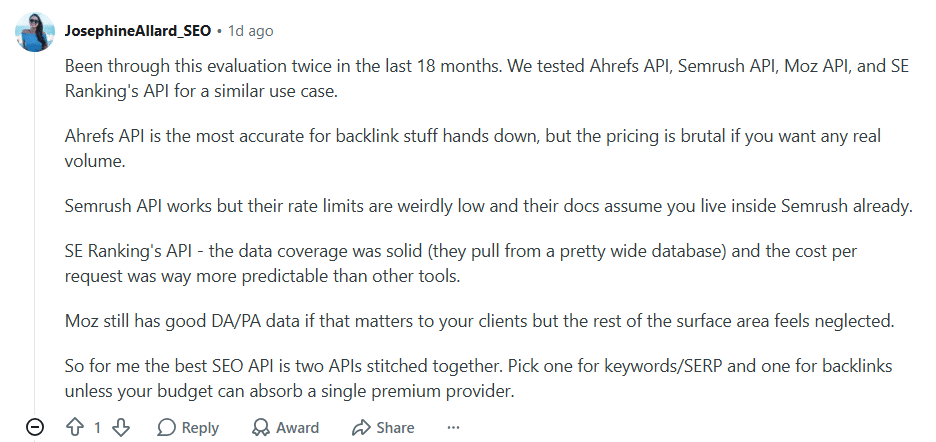
“Ahrefs API is the most accurate for backlink stuff hands down, but the pricing is brutal if you want any real volume.”
Nobody in the thread pushed back on the quality claim. The challenge was not the data, it was the cost of using it continuously. Agencies running dozens of client dashboards at once cannot keep absorbing premium pricing across every layer of their reporting stack without watching margins compress. At some point, the maths stops working.
That pressure is visibly changing how agencies buy. Several contributors landed on the same practical answer: use Ahrefs deliberately, for high-stakes audits and strategic reporting, and let lower-cost APIs carry the weight of continuous day-to-day operations.
Semrush Still Runs the Show for Reporting, But Friction Is Creeping In
Semrush has not lost its grip on reporting workflows, particularly for agencies built around keyword tracking and dashboard visualisation. One contributor called it the strongest platform available for reporting connected into BigQuery. Another said the API “works,” then carved out criticism for rate limits described as “weirdly low” and documentation written as though every developer already lives inside the Semrush ecosystem.
Developer friction that feels like a minor irritation at small scale becomes a real problem as automation expands. A small agency pushing out occasional reports can absorb a clunky integration or a failed request without much damage. A system powering dozens of automated dashboards cannot survive repeated interruptions without the cost showing up in engineering time, delayed reports, and compounding inefficiencies.
Somewhere along the way, the thread stopped reading like a conversation about SEO software and started reading like one about backend infrastructure and nobody seemed surprised by that shift.
DataForSEO Kept Surfacing as the Practical Answer

Ahrefs and Semrush carried the weight of reputation. DataForSEO kept getting mentioned as the tool that actually works when workloads get serious. One contributor called it “usually the most practical for building dashboards since it handles volume better and is more developer focused.” Another reached for it across keyword research, rank tracking, and backlink workflows without blinking.
The tone of those endorsements said something on its own. Nobody called DataForSEO exciting. Nobody claimed it was dominant. The comments stayed tight around practicality, how it handles implementation, how it scales, how it holds up under heavier request loads. That is the kind of language that surfaces when technical teams have quietly moved past caring about brand names and started caring about what actually runs reliably.
One more contributor brought Serper.dev into the mix for rank tracking, with Keywords Everywhere and Cloro filling out additional keyword workflows. By that point, the pattern in the thread was hard to ignore. Agencies are not buying into one platform and calling it a strategy anymore. They are building modular stacks, picking tools for specific jobs, and holding the whole thing together themselves.
Supporting Platforms Are Racing Toward AI and Automation
Product documentation across several providers tells you exactly where the market is heading. SE Ranking has repositioned its API around AI visibility tracking, keyword research, backlinks, domain analysis, and website audits, with integrations through APIs and MCP connections built for AI assistants including Claude, Gemini, and Cursor. The company puts its infrastructure at 5.4 billion keywords, 2.2 billion domain profiles, and 188 country databases.
Google’s BigQuery has framed itself as an “autonomous data and AI platform,” pulling Gemini-powered conversational analytics, predictive modelling, vector search, and AI agents directly into enterprise data operations. Ahrefs and Semrush have moved in the same direction, expanding MCP integrations and AI-assisted workflows that reach into developer environments and automated reporting systems.
Smaller providers are not standing still either. Search api has built its entire pitch around real-time Google Search API access, promising response times of one to two seconds and support for up to 300 queries per second. The SEO API market is starting to look less like a software competition and more like an infrastructure arms race.


