


- Lily Ray, a well-known SEO strategist, shared a Google Sheets formula that rewrites SEO keywords into natural-language AI search queries, accumulating over 25,000 views within hours and triggering sharp debate about usability, model reliability, and the structural limits of traditional keyword research.
- The discussion surfaces a shift already being documented across the SEO industry: as AI-assisted search interfaces attract more of the query volume previously directed at traditional search, keyword formats optimized for crawlers are increasingly misaligned with how real queries are being formed.
SEO Professionals Are Questioning Keyword Research. AI Search Is Why
Lily Ray dropped a Google Sheets formula on X. Within hours, it had pulled in 25,000 views and a comment section that had very little patience for small talk. Nobody was really debating the formula.
Ray, VP of SEO Strategy and Research at Amsive and founder of Algorythmic, posted the formula under @lilyraynyc.

The Formula Is Simple. The Problem It Points to Is Not
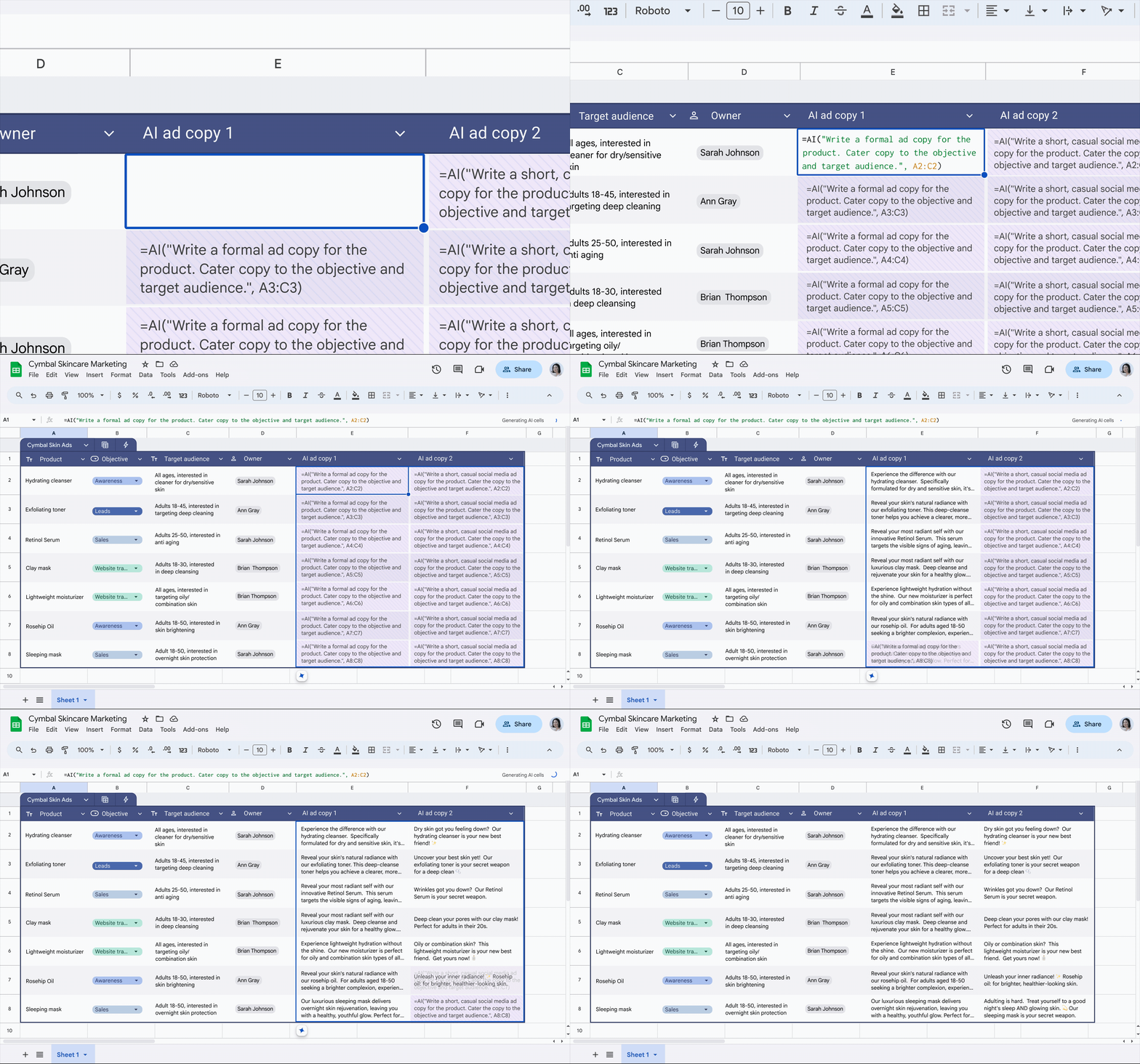
The whole thing runs inside Google Sheets’ built-in AI function. You put an SEO keyword in one cell. The formula sitting in the next cell tells the model to rewrite that keyword as a full question, the kind a real person would actually type into ChatGPT or say out loud to Gemini.
The prompt controlling that rewrite is tightly built. Search intent has to survive the translation, whether the original keyword was informational, commercial, transactional, or local. Brand names, product names, locations, all of it stays. The model is not allowed to invent constraints or add specifics that the keyword never implied. What comes out should be clean, plain text, no framing, no preamble, just the question.
Take “best car rental Dubai family.” Now take “what is the best car rental option in Dubai for a family travelling with young children.” Same intent. Completely different objects. SEO consultant Francisco Leon de Vivero published a breakdown of this workflow on June 10 and made the gap concrete: AI visibility tools track at prompt level, not at the keyword level. Feed them raw keyword exports and you get a tracker that measures something nobody is actually searching for.
Three Replies That Cut Through the Noise
I´ve tried the formula in Google Sheets and it gives me “ERROR”. I wonder why?
— Matthew Rubio (@thinksenseads) June 10, 2026
@thinksenseads: “I’ve tried the formula in Google Sheets and it gives me ‘ERROR’. I wonder why?”
That error is not a setup mistake. Google’s documentation spells it out: the AI function only works on eligible Workspace plans, and even then, administrators can block access entirely. Language settings can lock it out too. So before a team gets anywhere near a content strategy conversation, they hit a wall that has nothing to do with SEO. The same documentation confirms the batch cap, meaning large keyword sets get processed in stages, with waiting built into the process.
I’ve seen at length variations of this through ChatGPT which was like no sir I am not entering all that in over 600 words plus
— AdamHumphreys (@AdamJHumphreys) June 9, 2026
@AdamJHumphreys: “I’ve seen at length variations of this through ChatGPT which was like no sir I am not entering all that in over 600 words plus”
That frustration is fair. A prompt running over 600 words, applied across a keyword set in the thousands, is not a light lift. Leon de Vivero’s analysis suggests working in topic clusters, finishing the QA pass on each batch before touching the next one. As a test on a focused set of keywords, the technique holds up. As a production pipeline for a large site, the friction adds up fast.
the honest answer is that most ai models still don’t understand what “natural language” means, so this trick might actually be working by accident or through sheer luck
— Adel Bucetta (@adelbucetta) June 9, 2026
@adelbucetta: “The honest answer is that most AI models still don’t understand what ‘natural language’ means, so this trick might actually be working by accident or through sheer luck”
That one lands differently than the others. Google’s 2019 BERT announcement is worth remembering here: search systems read words as numerical signals, not as language the way a person reads it. Rewriting a keyword as a conversational question changes the numerical input.
Whether that change actually improves how AI systems retrieve and surface content is a question that architecture and context answer differently every time. Nobody has a clean answer yet. The doubt is earned.
The Numbers Behind Why This Debate Is Happening Now
The formula is not the story. What pushed Ray to build it is.
Chartbeat data pulled from more than 2,500 websites shows that small publishers lost 60 percent of their search referral traffic over the past two years. Demand Local’s industry analysis puts the broader range at 30 to 70 percent, with HubSpot as the headline case: 70 to 80 percent of its organic traffic gone between late 2024 and mid-2025. Even the queries that still land on a traditional search bar often never reach a publisher.
An AI layer answers them first. AI chatbot referrals send roughly 96 percent less traffic than traditional search. When AI does cite a source, users click through about one percent of the time.
Keyword Research Was Built for a Different Machine
Google’s AI Overviews and AI Mode do not work like a document retrieval system. Research into query fan-out in agentic search shows that when an AI constructs a response, it may fire off several related sub-queries across different subtopics at once. One short keyword becomes multiple retrieval paths. Leon de Vivero puts it simply: the keyword is the seed, not the full research object. This shift is also reflected in some other emerging AI developer tools such as Runway’s Characters API, which rely on natural-language inputs rather than isolated keywords.
Keyword research was designed to talk to crawlers. Short phrases, modifier combinations, volume clusters, that entire methodology was built to match text patterns against indexed URLs and pull back a ranked list. Google started shifting the underlying mechanism with BERT, moving toward intent inference and contextual understanding. The search engine changed. The research toolkit mostly stayed where it was.
What the SEO Industry Is Actually Doing About It?
Ray’s formula is one way to close the gap, not the only one. Leon de Vivero’s workflow goes further: export keywords with volume, intent classification, and current URL data attached; convert to prompts in batches; run a QA pass specifically to catch prompts that invented specifics or drifted from the original intent; then put the clean prompt set to work across AI visibility tracking, content gap analysis, and page refresh decisions.
A prompt that invents a price range or an audience qualifier that the original keyword never contained has already broken from its source data. The volume behind that keyword no longer supports it. Human review is not optional here; it is the step that keeps the whole workflow from drifting into fiction. These are model-generated approximations of demand, not records of real searches.
The real question sitting underneath all of this is whether keyword research, as a discipline, needs to be rebuilt from a different foundation to match how people actually form queries in an AI-mediated search environment. The speed at which 25,000 people engaged with a single spreadsheet formula suggests that the question is no longer theoretical. It is already on the table.
Expert Analysis
Ray’s formula is useful because it exposes a practical gap in current SEO workflows: keyword data is still valuable, but it does not always translate cleanly into the way people ask questions in AI search interfaces.
Classic keyword research gives SEOs demand signals, intent clues and a starting point for content planning. The problem is not the data itself. The problem is the format. A short keyword export is not the same thing as a natural-language prompt a user might enter into ChatGPT, Gemini or Perplexity.
That makes the formula less of a shortcut and more of a translation step. It helps turn keyword inputs into prompt-style questions that can be tested across AI visibility tools, content gap workflows and page refresh decisions.
The risk starts when those generated prompts are treated as exact records of real user behavior. They are not. They are model-assisted approximations based on existing keyword data, and they still need human review to catch drift, invented details or intent changes.
That is the stronger takeaway from the debate around Ray’s post. SEO teams are not throwing away keyword research. They are trying to adapt it for a search environment where queries are becoming more conversational, answers are generated and source selection is harder to see.


