


- A pSEO-heavy site owner says Google traffic dropped roughly 93% overnight, then stayed almost dead for close to a year.
- The Reddit thread is only one public case, but it shows why SEOs are becoming more cautious with scaled content, site structure and domain-level trust.
Nobody inside SEO really trusts “recovery” screenshots anymore.
Fake charts have flooded the space. Cropped analytics graphs get passed off as proof. Sellers push resurrection stories five days after Google crushes their traffic.
That cynicism is exactly what made this particular Reddit thread interesting.
The numbers were too modest, too uneven and too unglamorous to feel like a clean marketing case study.
A site owner posted screenshots of a programmatic SEO project that reportedly lost roughly 93% of its Google traffic in early April 2025, then spent almost a full year sitting half-dead before impressions began edging back.
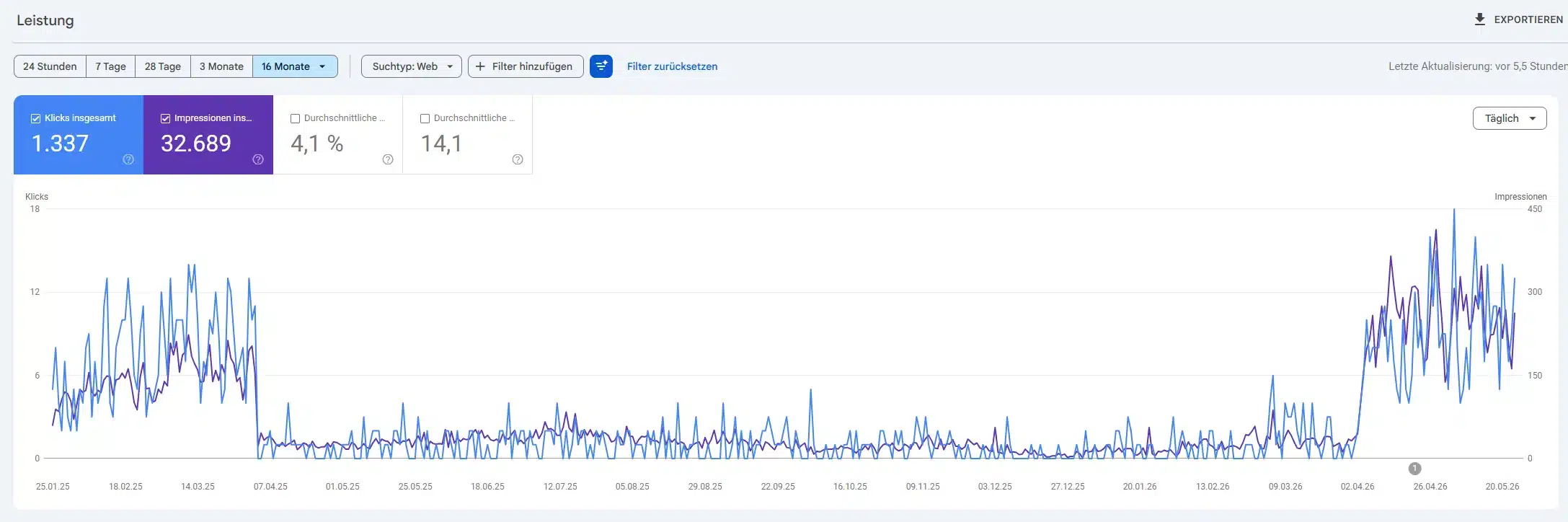
This is an anecdotal Reddit case, not a confirmed Google recovery study. Still, the discussion captures a bigger question many SEOs are trying to answer: where does useful programmatic SEO end and scaled content abuse begin?
Not surging. Not recovering in any dramatic way. Just crawling back slowly, like something unsure it was allowed to move again.
The thread itself was messy, which honestly made it feel more real. Arguments in English, arguments in Portuguese, half-jokes about AI, spam penalties, PageRank, backlinks, authority, scaled content abuse, internal links and the usual SEO forum chaos.
But buried under all of it was the question the industry keeps circling:
What exactly is Google punishing now?
Google did not slowly demote the site. It buried it.
Before everything fell apart, the project looked like many smaller pSEO builds from that period.
Roughly 12 to 18 clicks a day. Somewhere between 200 and 450 daily impressions. Rankings sitting around positions 10 to 15.
Nothing remarkable, but enough movement to convince the owner that the system was working.
Then April arrived.
Daily clicks collapsed from roughly 15 to about one. The owner put it simply:
“my page got NUKED.”
No slow fade. No obvious warning signs. No gentle slide down the rankings. The graph just folded in on itself.
Weeks went by. Then months. During the worst period, traffic barely moved above zero to two clicks a day. December 2025 reportedly produced just seven clicks across the entire month.
Rankings had drifted into the 20 to 40+ range and hardened there.
A lot of SEO people know that shape immediately. Not the exact numbers, but the behavior. Google has always knocked individual pages down. What has rattled publishers over the last couple of years is something broader: entire domains losing visibility at once.
The thread kept pulling back to programmatic SEO because it was the obvious suspect.
Thousands of pages. Heavy keyword expansion. Repeated structures. Limited differentiation between one page and the next.
Google has become much clearer about this risk since the March 2024 core update and spam policy changes. In that update, Google said it was taking stronger action against scaled content abuse, expired domain abuse and site reputation abuse.
Its scaled content abuse policy defines the problem as creating many pages primarily to manipulate search rankings rather than help users.
Still, even among people who work inside SEO every day, nobody seems fully certain where the actual line sits.
That uncertainty now shadows almost every conversation about AI-assisted publishing and programmatic SEO.
The recovery did not start with clicks
Easy to miss if you only glanced at the screenshots: traffic did not suddenly bounce back after the rebuild.
Impressions moved first.
That does not prove exactly what Google was doing, but it fits a pattern many SEOs watch after a long decline: Google starts showing pages more often before clicks meaningfully return.
The owner rebuilt around a scattered set of inputs, including WebLinkr discussions, markdown notes, YouTube transcripts, Claude Code, Google Search Console data and DataForSEO feeds.
No perfect technical breakdown ever came. The thread never became a neat case study. It wandered, contradicted itself and doubled back.
Which, honestly, made it feel more real than most things that get posted in SEO forums.
Eight-week recovery window
| Week of | Clicks | Impressions |
|---|---|---|
| March 30 | 28 | 5,542 |
| April 6 | 27 | 6,615 |
| April 13 | 46 | 6,624 |
| April 20 | 49 | 7,722 |
| April 27 | 55 | 7,698 |
| May 4 | 43 | 9,365 |
| May 11 | 47 | 9,421 |
| May 18 | 56 | 6,324 |
28-day comparison
| Metric | Value |
|---|---|
| Clicks | 200 (+31%) |
| Impressions | 32,564 (+21%) |
| CTR | 0.61% |
| Average position | 13.3 |
By enterprise SEO standards, those numbers are nothing.
Still, people stopped and looked.
Artificial growth often looks too clean. This one was awkward. Some weeks climbed, others sagged. Impressions pushed forward while clicks lagged behind. Momentum kept hesitating.
Real recoveries often look like that. Not because anyone can prove exactly what Google is doing behind the scenes, but because search visibility rarely returns in a perfectly straight line.
Authority kept coming up, no matter where the thread went
At some point, another user cut through the noise and asked what the actual advice was.
The owner replied with one word:
“Authority.”
The conversation then moved into PageRank, internal links, external promotion, site structure and what that single word actually means in practice.
The owner had stopped thinking in terms of raw page volume. The focus had shifted to how authority travels through a site, which pages carry weight, which ones deserve internal links and which expansions actually make sense without eating into URLs that already have traction.
That shift matters because the old pSEO model often ran in reverse:
- Publish first.
- Scale fast.
- Fix quality later.
That was the sequence.
Google tolerated versions of this for years because search systems were coverage-hungry. Build enough pages across enough keyword variations and some rankings would often follow, even if whole sections of the site were structurally similar underneath the surface.
Something has changed.
Or perhaps Google simply caught up technically with what publishers had been doing for years.
Inside the thread, WebLinkr kept drawing a line between programmatic SEO and scaled content abuse, treating them as separate things.
That distinction is important.
Amazon, Reddit, job boards, marketplaces, directories and ecommerce sites all use programmatic systems. That is not the same as flooding a domain with near-identical keyword pages.
The problem begins when publishers run large keyword lists through content production systems and create pages that barely differ from one another.
Google’s guidance on AI-generated content makes the same point from another angle: using AI or similar tools to generate many pages without adding value for users may violate its scaled content abuse policy.
The problem is that nobody fully knows where Google draws the line in practice.
Not even people who have spent years in the industry.
Then a publisher showed up with the opposite story
Midway through the thread, a Brazilian publisher entered the conversation with a completely different experience.
New domain. Five months old. Roughly 400 AI-generated pages. Strong organic growth.
According to that user, the project was already pulling:
| Source | Monthly clicks |
|---|---|
| Google Organic | ~10,000 |
| Bing | ~2,500 |
| Yahoo | ~1,000 |
| Total organic visits | ~15,000 |
That immediately complicated things.
If scaled AI content triggered penalties automatically, this site should have been dead.
The operator argued the difference was execution:
- Faster UX
- Cleaner structure
- Better accessibility
- Lower duplication
- Stronger page speed
- Unique FAQs
- Unique layouts
- Less template repetition across pages
The programmatic system was just one layer inside a broader build that, according to the operator, prioritized trust signals throughout.
That part of the thread mattered, not because it disproves anything about the original collapse, but because it exposes how fractured the industry’s understanding has become.
Two operators can both call what they are doing “pSEO” while running completely different systems underneath.
One floods search results with interchangeable pages.
The other builds a lean topical engine with cleaner structure, better UX and more differentiated pages.
From the outside, those two approaches can look almost identical.
Google may not see them that way.
The SEO industry is quietly rebuilding around trust signals again
For years, the conversation inside SEO centered on one thing:
More pages. More keywords. More coverage. More automation.
The vocabulary has shifted.
Now the threads are full of internal links, authority flow, topical relationships, crawl efficiency, page overlap, site coherence and historical trust.
It sounds almost old-school, like a decade of industrialized publishing got reversed and people are reading 2012 SEO blog posts again.
The irony is not subtle.
After years spent industrializing search visibility, Google may be pulling the industry back toward the slower, more deliberate approach that worked before automation became cheap.
Google’s broader helpful content guidance points in the same direction: content should be made for people, not primarily to manipulate search rankings.
This also connects to the wider debate around whether AI search optimization is still just SEO. The fundamentals still matter, but the tolerance for weak scaled content appears much lower than it used to be.
The original site owner described the recovery process almost like a cautious formula:
“rank for keyword -> expand to similar keywords but be careful -> expand and so on.”
That word, careful, carries more weight than it looks.
Because the fear has changed.
It is no longer only about whether a single page will rank.
The question now is:
Will the entire domain get labeled as low-value inventory?
Once that classification appears to stick, recovery can be brutal.
Not days. Not weeks. Sometimes a full year. Sometimes longer than that.
The Query Post view
The real takeaway from this Reddit case is not that the site came back.
It is the way it reportedly came back.
Google appears more willing to reward sites that undergo serious cleanup than sites that keep expanding mechanically around keyword lists.
That shifts where the operational risk sits for publishers running AI-assisted or programmatic workflows.
Recovery no longer means refreshing a few articles or adjusting metadata.
It can mean:
- Consolidating URLs
- Cutting thin pages
- Rebuilding internal link structures
- Improving crawl paths
- Tightening topical architecture
- Reducing duplication across whole domains
In practical terms, many SEO teams may end up spending more time cleaning what already exists than building anything new.
The wider market consequences could be significant.
Publishers built entirely around mass-page generation face rising structural risk as Google continues tightening how it evaluates large volumes of low-value content.
Operators investing in authority layering, UX performance, coherent topical systems and slower expansion may end up with a stability that the volume-first crowd cannot buy.
There is one more uncomfortable possibility under all of this:
Google itself may still be working out where the boundaries are.
That could explain why recoveries often feel inconsistent, partial and cautious. Impressions return before rankings. Rankings wobble before clicks. Clicks crawl back in no clean pattern.
Search visibility now behaves less like a switch being flipped and more like a period of supervised probation.
Which leaves the industry in an odd position.
Still scaling. Still automating. Still testing.
But doing all of it with one eye watching for the graph to fold again.
The confidence that used to come with volume is gone.
What replaced it is something quieter and considerably less comfortable.


