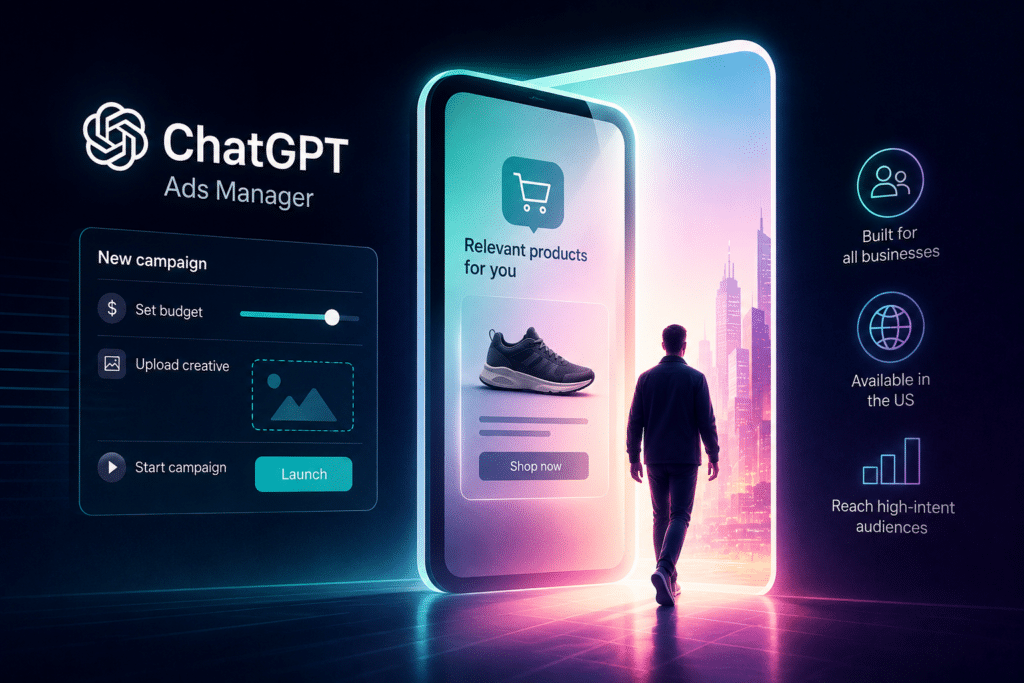
OpenAI is taking the next step in turning ChatGPT into an advertising platform. The company has started rolling out a beta self-serve Ads Manager that allows US advertisers to sign up and buy ads directly inside ChatGPT.
The update moves ChatGPT ads beyond a limited pilot with selected advertisers and agency partners. In its announcement, OpenAI said advertisers can now create campaigns through partners or through the new beta Ads Manager, with cost-per-click bidding and expanded measurement tools also being introduced.
For small and midsize businesses, the significance is clear: ChatGPT ads are starting to look less like an experimental brand placement and more like a self-serve performance channel.
ChatGPT Ads Move Beyond the Pilot Phase
OpenAI first tested ads in ChatGPT with a smaller group of advertisers. The new rollout broadens access and gives businesses a more familiar way to buy, manage and measure campaigns.
According to OpenAI, advertisers can use partners to access ChatGPT ads through existing tools and workflows, while OpenAI’s own ads system controls delivery decisions. The company also said it is beginning to roll out a beta self-serve Ads Manager for US advertisers who want to purchase ads directly.
The company has been working with major agency partners including Dentsu, Omnicom, Publicis and WPP. It has also added technology partners such as Adobe, Criteo, Kargo, Pacvue and StackAdapt.
That partner list matters. OpenAI is not only testing ad formats. It is building the buying, bidding, budgeting, creative and measurement infrastructure needed for a broader ads business.
Why Self-Serve Access Matters
Self-serve access is one of the reasons Google and Meta became dominant advertising platforms. It allows millions of advertisers to create campaigns without direct sales relationships, large agency retainers or custom media deals.
OpenAI is now moving in the same direction, but with a different surface. ChatGPT is not a social feed or a search results page. It is a conversational product where users ask questions, compare options, plan decisions and look for recommendations.
That makes the ad opportunity different. A user asking ChatGPT about software, travel, finance, home services or product options may be much closer to a decision than someone passively scrolling a feed.
Axios reported that the self-serve launch is designed to broaden access to ChatGPT advertising and help OpenAI scale its ad business beyond large managed campaigns.
CPC Bidding Makes ChatGPT Ads More Familiar
OpenAI is also introducing cost-per-click bidding. That gives advertisers a pricing model they already understand from search, shopping and performance marketing campaigns.
In practical terms, this makes ChatGPT ads easier to test. Advertisers do not only need to think in terms of brand exposure or experimental AI placements. They can start evaluating clicks, budgets, pacing and performance in a more familiar framework.
OpenAI’s ChatGPT ads documentation says ads appear below relevant conversations and include an advertiser name, favicon, headline, description, landing page and image asset. OpenAI also says conversations and personal details are not shared with advertisers.
That separation is important because it shapes how ChatGPT ads may work as a channel. Brands are not paying to control the answer itself. They are buying sponsored placements around relevant user intent.
The Meta Comparison Is Hard to Avoid
OpenAI is not building another social network, but the comparison with Meta is hard to avoid. Meta’s ad system became powerful because it combined massive user attention, automated targeting, creative testing and self-serve access for businesses of every size.
OpenAI has a different advantage: conversational intent. People use ChatGPT to solve problems, make decisions and understand options. If ads can appear in that environment without damaging trust, ChatGPT could become a serious new layer in the performance marketing stack.
That does not mean ChatGPT ads are ready to replace Meta ads. Meta still has enormous scale across Facebook, Instagram, WhatsApp and Messenger, as well as mature advertiser tools and years of performance data.
But OpenAI is now building the pieces advertisers expect from a serious platform: direct access, partner integrations, CPC bidding and measurement.
The Trust Problem Is Bigger Than in Social Ads
Advertising inside an AI assistant is more sensitive than advertising inside a feed. Users may treat ChatGPT as a research tool, planning assistant or decision helper. If ads appear too close to recommendations, or if users believe paid placements influence the assistant’s answer, trust can quickly become an issue.
OpenAI appears aware of that risk. In its announcement, the company said the experience is designed to remain useful, private and clearly separate from ChatGPT’s answers. Its help documentation also states that ads are shown below relevant conversations rather than inserted as hidden recommendations.
This distinction will matter for advertisers too. If ChatGPT maintains user trust, ads may benefit from a high-intent environment. If users feel the assistant is becoming too commercial, OpenAI may face the same credibility problem that search and social platforms have dealt with for years.
What Marketers Should Watch
For marketers, the key question is not whether ChatGPT ads are interesting. They obviously are. The real question is whether they can perform at scale.
Advertisers should watch several things closely:
- Placement quality: where ads appear and how relevant they are to the user’s task.
- Measurement: how clearly clicks, conversions and post-click behavior can be tracked.
- Creative format: whether classic display-style creative works in a conversational environment.
- User trust: whether ads feel helpful or intrusive inside ChatGPT.
- Budget access: whether smaller advertisers can test the channel without heavy minimum commitments.
The biggest opportunity may be for advertisers whose products already match research-heavy user behavior: software, business tools, education, finance, travel, local services and comparison-driven e-commerce.
AI Advertising Is Becoming Infrastructure
OpenAI’s self-serve Ads Manager is part of a broader shift. AI assistants are becoming new surfaces for discovery, research and decision-making. That makes them attractive to advertisers, but also raises new questions about transparency, measurement and user control.
Google is adding AI deeper into Search and its advertising products. Meta is building AI tools across its apps and ad systems. OpenAI is now turning ChatGPT into a more accessible ad channel.
The competition is no longer only about who has the best model. It is also about who owns the user journey when people ask questions, compare options and decide what to do next.
The Bottom Line
OpenAI’s beta Ads Manager makes ChatGPT advertising look more like a real self-serve channel. With direct US advertiser access, CPC bidding, agency integrations and measurement tools, the company is laying the foundation for an AI-native ad platform.
For Meta and Google, the threat is not that ChatGPT instantly replaces their ad businesses. The threat is that a new intent layer is emerging outside traditional search results and social feeds.
For advertisers, ChatGPT ads are still early. But they are no longer just a curiosity. They are becoming a new place to test how AI-driven discovery turns into paid traffic.