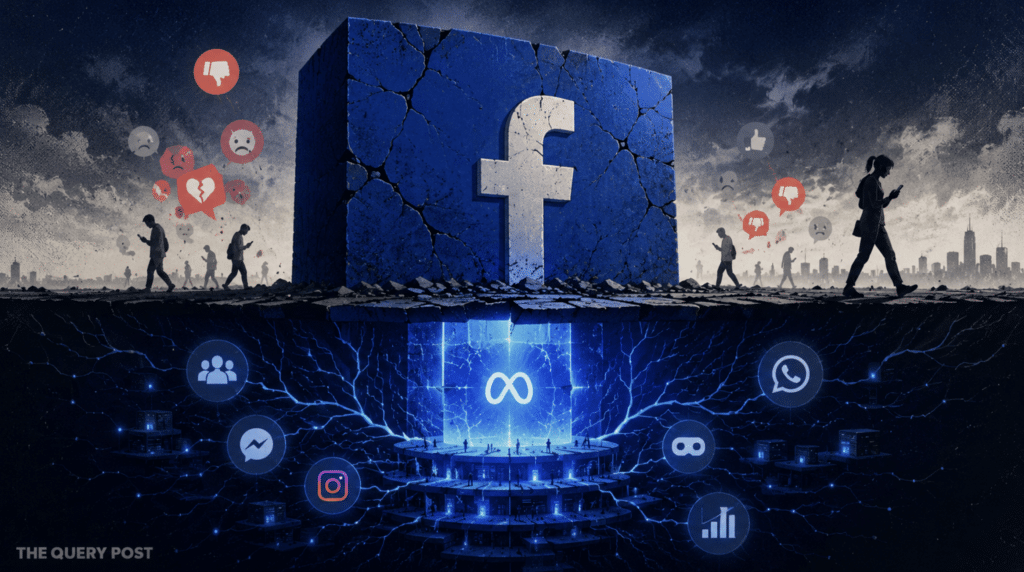
Meta is facing a familiar question again: is Facebook becoming the next aging internet platform, or is the company simply moving beyond the version of social media that made it dominant?
The debate picked up after a recent New York Times opinion piece by Julia Angwin argued that Meta is entering a long decline. The article described Facebook as moving into a “zombie era,” with younger users increasingly viewing the platform as outdated and culturally irrelevant.
Social Media Today pushed back on the broader conclusion, arguing that while Facebook’s cultural relevance has clearly weakened, calling Meta itself a dying company is much harder to support.
Meta did lose daily active users
The latest numbers gave critics a reason to look more closely.
In its Q1 2026 earnings report, Meta said family daily active people averaged 3.56 billion in March 2026. That was still up 4% year over year, but down slightly from the previous quarter.
Meta said the quarter-over-quarter decline was driven by internet disruptions in Iran and restrictions on WhatsApp access in Russia. According to MarketWatch, the figure fell from 3.58 billion in December 2025 to 3.56 billion in March 2026, a drop of about 20 million daily active people across Meta’s apps.
That is not meaningless. Meta’s products include Facebook, Instagram, WhatsApp, Messenger and Threads. A decline across the family of apps is notable because Meta has historically been able to rely on enormous global reach even when one individual platform slowed.
But scale matters. At 3.56 billion daily active people, Meta remains one of the most widely used digital platforms in the world.
Facebook is weaker than Meta
The stronger argument is not that Meta is dying tomorrow. It is that Facebook no longer defines digital culture in the way it once did.
Facebook has become less central for younger users, and social media has shifted away from friend-to-friend updates toward entertainment feeds, short-form video, creator content and algorithmic recommendations. TikTok accelerated that shift, while Instagram has increasingly followed the same entertainment-first model.
That changes what Facebook is. It may still be useful for groups, local communities, older audiences, events, marketplace activity and family updates. But it is no longer the place where the future of social media feels like it is being invented.
That is the part of the “Facebook is dead” argument that is harder to dismiss. A platform can remain huge while becoming less culturally important.
The ad business is still very much alive
The problem with the “Meta is dying” framing is the business itself.
Meta reported Q1 2026 revenue of $56.31 billion, up 33% year over year. Ad impressions across its family of apps increased 19%, while the average price per ad rose 12%.
That is not what a collapsing advertising business looks like.
For marketers, Meta remains one of the core paid social channels. Even if Facebook is less culturally exciting, Meta’s ad machine still benefits from Instagram, Reels, WhatsApp, AI-driven targeting and massive cross-platform reach.
The company’s full-year 2025 revenue also reached $200.97 billion, up about 22% year over year, according to StockAnalysis. That gives Meta a large financial base to fund new bets, even expensive ones.
The real risk is the next interface
Meta’s bigger challenge is not whether Facebook remains cool. It is whether the company can control the next major interface after the social feed.
That explains the heavy spending on AI, glasses, wearables and immersive computing. Meta has already spent years and billions trying to build toward VR and the metaverse. Now the focus has shifted more heavily toward AI infrastructure, AI assistants, AI-powered recommendations and smart glasses.
Investors are watching that spending closely. Meta raised its 2026 capital expenditure forecast to between $125 billion and $145 billion, largely tied to AI infrastructure and data center needs.
That is the real strategic question. Meta’s current ad business is still powerful. But the company is spending aggressively to avoid being trapped inside aging platforms while AI reshapes discovery, communication and advertising.
What marketers should take from this
For marketers, the practical takeaway is not to abandon Meta. The audience is still enormous, and the advertising system remains deeply embedded in performance marketing.
But the way people use Meta’s platforms is changing. Facebook may be less useful as a cultural signal, while Instagram, Reels, WhatsApp, AI recommendations and paid placements become more important parts of the overall system.
That means marketers should separate three questions:
- Is Facebook culturally declining? Probably, especially among younger audiences.
- Is Meta’s ad business declining? Not based on the latest revenue and ad metrics.
- Is Meta guaranteed to win the next AI-driven platform shift? No, and that is where the risk sits.
The Query Post view
The “Meta is dying” argument works as a cultural critique. Facebook feels older, less exciting and less central than it used to. User behavior has changed, and social media is no longer mainly about friends posting to friends.
But as a business story, the claim is much weaker.
Meta is still growing revenue, still increasing ad impressions, still reaching billions of people daily and still generating the cash needed to invest aggressively in AI. The more accurate view is that Facebook is aging while Meta is trying to turn itself into the infrastructure layer for the next phase of digital attention.
That transition may fail. But it is not the same as dying.