


- AEO is not replacing SEO, but it is exposing a weakness in how many brands think about visibility.
- AI systems appear to rely heavily on external trust signals, not just what a company says on its own website.
- The biggest problem for marketers is still measurement: AI citations and mentions are easier to track than they are to connect to revenue.
Most of the AEO debate starts in the wrong place.
Marketers keep asking whether Answer Engine Optimization is just SEO with a new name. In one sense, that criticism is fair. Strong content still matters. Technical SEO still matters. Authority still matters. If a site cannot be crawled, understood or trusted, no AI-focused playbook will save it.
But that does not mean nothing has changed.
The real shift is not that SEO fundamentals have disappeared. The shift is that AI systems can make brands invisible even when their websites look technically sound. A company can have useful content, decent rankings and a clean site, yet still fail to appear when ChatGPT, Perplexity, Claude or Google’s AI features summarize the market.
That is where the AEO discussion becomes more interesting.
The AEO Debate Is Really a Trust Debate
The strongest argument from the community discussion was not about schema, headings or FAQ blocks. It was about external validation.
One comment captured the issue clearly:
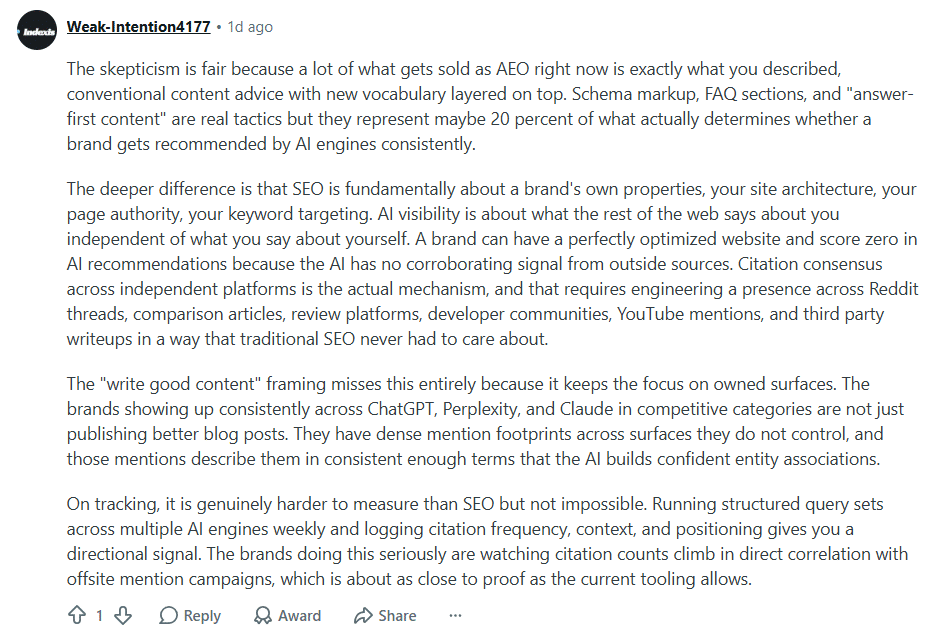
“A brand can have a perfectly optimized website and score zero in AI recommendations because the AI has no corroborating signal from outside sources.”
That is the part many traditional SEO checklists do not fully cover.
A website shows what a company says about itself. Reviews, forum discussions, comparison pages, third-party articles, customer comments and industry mentions show what the rest of the web says about it.
AI systems do not operate like a normal user clicking through a homepage. They pull from a wider information layer. They look for patterns, repeated references and sources that appear reliable enough to use inside an answer.
That does not mean every forum mention is a ranking factor. It does mean brands should stop treating off-site reputation as something separate from search visibility.
Google’s own guidance on AI features still points back to core search quality systems, useful content and accessible pages. But AI search also makes one thing harder to ignore: if the wider web does not support your brand, your own website may not be enough.
AEO Is Not a New Playbook. It Is a New Selection Problem.
The weaker version of AEO sounds like this: add summaries, write FAQs, use schema and hope AI tools quote you.
That is too shallow.
The stronger version is about selection.
When an AI system answers a question, it has to decide which sources and brands are safe to mention. That decision is not only about whether your page is relevant. It is also about whether your brand looks credible enough across the web.
That is why the line between SEO, digital PR, reviews, brand building and community visibility is getting blurrier.
For years, many teams treated those as separate channels. SEO handled rankings. PR handled mentions. Customer teams handled reviews. Social handled communities. AI search is making that separation look less realistic.
If answer engines use a mix of content, citations, reputation and entity signals, then a brand’s visibility depends on more than its blog.
The Citation Economy Still Has a Measurement Problem
Another comment from the discussion put the tension in simple terms:

“SEO optimizes for clicks. AEO optimizes for citations.”
It is a catchy line, and it explains why marketers are paying attention. In classic search, the path was easier to measure: rankings, impressions, clicks, traffic and conversions.
AI search breaks that chain.
A brand may appear in an AI answer without getting a click. It may be mentioned without being cited. It may influence a buyer before that buyer ever visits the website. Or it may be used as background information without receiving visible credit.
That creates a difficult question: what is an AI citation worth?
Right now, most brands can track signals, not certainty. They can monitor mentions across ChatGPT, Perplexity, Gemini or Google AI Overviews. They can compare their visibility against competitors. They can check whether AI systems describe the brand correctly. But tying those appearances directly to revenue is still messy.
That is why the hype around AI visibility tools should be treated carefully. A dashboard full of citations may look impressive, but it does not automatically prove business impact.
For marketers, the better question is not “how many times were we cited?” It is: “Are we appearing in the answers that influence real buying decisions?”
External Validation Is Becoming Harder to Ignore
The most useful part of the AEO discussion was the repeated focus on signals outside the brand’s own site.
One participant framed the shift this way:
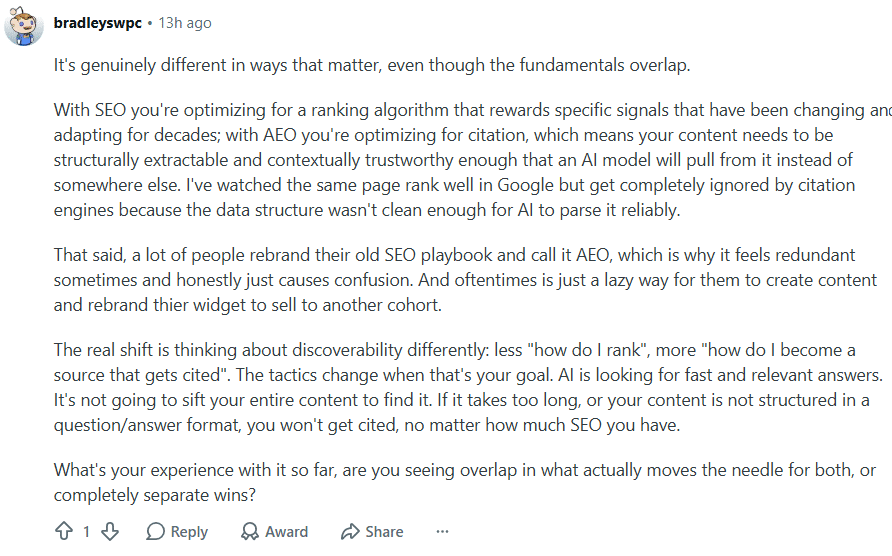
“The real shift is thinking about discoverability differently: less ‘how do I rank’, more ‘how do I become a source that gets cited.’”
That is a better way to think about the problem.
Ranking is still important. But AI search adds a second question: does your brand deserve to be included in the answer?
That inclusion may depend on several things:
- Whether your content answers questions clearly.
- Whether your brand is mentioned by credible third parties.
- Whether reviews and customer discussions support your positioning.
- Whether your company information is consistent across the web.
- Whether your pages are easy to understand, extract and cite.
- Whether your brand is associated with a clear category or problem.
This is also why the debate around AEO, GEO and AI visibility often becomes confusing. The labels are messy, but the underlying issue is real. Search is moving from page ranking toward answer selection.
As The Query Post has covered before, Google continues to argue that AI search optimization is still SEO, not a separate discipline. That may be true at the foundation level. But it does not remove the practical problem: many brands still need to strengthen the signals that make them easier to identify, verify and cite.
This Is Bigger Than Marketing
The AEO debate also connects to a wider question: who gets visibility when AI systems become the interface between users and information?
Regulators are already looking at how foundation models, data access and deployment channels may shape competition. The UK Competition and Markets Authority has warned about the risk of a small number of firms controlling key inputs and routes to market in AI foundation models. The CMA said these markets could develop in ways that harm competition if not monitored carefully.
Publishers face a related problem. If AI systems summarize content and reduce the need to click through, the question is not only who gets cited. It is who gets paid, who gets traffic and who gets credit for original work.
That is why AEO should not be dismissed as just another SEO acronym. The commercial stakes are real, even if the terminology is still ugly.
What Marketers Should Actually Do
The practical response is not to throw away SEO and chase every new AI visibility tactic.
The better response is to widen the checklist.
Start with the basics: technical health, strong pages, clear answers, internal links, authorship and crawlability. Then look beyond the website.
Ask:
- Do trusted third-party sources mention the brand?
- Do reviews support the claims made on the website?
- Do comparison pages, industry articles or community discussions include the brand?
- Do AI systems describe the company correctly?
- Do competitors appear in AI answers where the brand is missing?
- Are the pages that should be cited actually clear enough to cite?
That is a more useful way to approach AEO than simply adding another optimization layer to existing blog posts.
For teams already seeing traffic changes from AI search, this also connects to a bigger reporting problem. Rankings may stay stable while clicks fall or AI visibility changes elsewhere. That is one reason we have argued that AI search is creating a visibility gap SEO tools cannot fully explain.
Key Points
- AEO is not replacing SEO, but it is exposing a weakness in how many brands think about visibility.
- AI systems appear to rely heavily on external trust signals, not just what a company says on its own website.
- The biggest problem for marketers is still measurement: AI citations and mentions are easier to track than they are to connect to revenue.
Most of the AEO debate starts in the wrong place.
Marketers keep asking whether Answer Engine Optimization is just SEO with a new name. In one sense, that criticism is fair. Strong content still matters. Technical SEO still matters. Authority still matters. If a site cannot be crawled, understood or trusted, no AI-focused playbook will save it.
But that does not mean nothing has changed.
The real shift is not that SEO fundamentals have disappeared. The shift is that AI systems can make brands invisible even when their websites look technically sound. A company can have useful content, decent rankings and a clean site, yet still fail to appear when ChatGPT, Perplexity, Claude or Google’s AI features summarize the market.
That is where the AEO discussion becomes more interesting.
The AEO Debate Is Really a Trust Debate
The strongest argument from the community discussion was not about schema, headings or FAQ blocks. It was about external validation.
One comment captured the issue clearly:
“A brand can have a perfectly optimized website and score zero in AI recommendations because the AI has no corroborating signal from outside sources.”
That is the part many traditional SEO checklists do not fully cover.
A website shows what a company says about itself. Reviews, forum discussions, comparison pages, third-party articles, customer comments and industry mentions show what the rest of the web says about it.
AI systems do not operate like a normal user clicking through a homepage. They pull from a wider information layer. They look for patterns, repeated references and sources that appear reliable enough to use inside an answer.
That does not mean every forum mention is a ranking factor. It does mean brands should stop treating off-site reputation as something separate from search visibility.
Google’s own guidance on AI features still points back to core search quality systems, useful content and accessible pages. But AI search also makes one thing harder to ignore: if the wider web does not support your brand, your own website may not be enough.
AEO Is Not a New Playbook. It Is a New Selection Problem.
The weaker version of AEO sounds like this: add summaries, write FAQs, use schema and hope AI tools quote you.
That is too shallow.
The stronger version is about selection.
When an AI system answers a question, it has to decide which sources and brands are safe to mention. That decision is not only about whether your page is relevant. It is also about whether your brand looks credible enough across the web.
That is why the line between SEO, digital PR, reviews, brand building and community visibility is getting blurrier.
For years, many teams treated those as separate channels. SEO handled rankings. PR handled mentions. Customer teams handled reviews. Social handled communities. AI search is making that separation look less realistic.
If answer engines use a mix of content, citations, reputation and entity signals, then a brand’s visibility depends on more than its blog.
The Citation Economy Still Has a Measurement Problem
Another comment from the discussion put the tension in simple terms:
“SEO optimizes for clicks. AEO optimizes for citations.”
It is a catchy line, and it explains why marketers are paying attention. In classic search, the path was easier to measure: rankings, impressions, clicks, traffic and conversions.
AI search breaks that chain.
A brand may appear in an AI answer without getting a click. It may be mentioned without being cited. It may influence a buyer before that buyer ever visits the website. Or it may be used as background information without receiving visible credit.
That creates a difficult question: what is an AI citation worth?
Right now, most brands can track signals, not certainty. They can monitor mentions across ChatGPT, Perplexity, Gemini or Google AI Overviews. They can compare their visibility against competitors. They can check whether AI systems describe the brand correctly. But tying those appearances directly to revenue is still messy.
That is why the hype around AI visibility tools should be treated carefully. A dashboard full of citations may look impressive, but it does not automatically prove business impact.
For marketers, the better question is not “how many times were we cited?” It is: “Are we appearing in the answers that influence real buying decisions?”
External Validation Is Becoming Harder to Ignore
The most useful part of the AEO discussion was the repeated focus on signals outside the brand’s own site.
One participant framed the shift this way:
“The real shift is thinking about discoverability differently: less ‘how do I rank’, more ‘how do I become a source that gets cited.’”
That is a better way to think about the problem.
Ranking is still important. But AI search adds a second question: does your brand deserve to be included in the answer?
That inclusion may depend on several things:
- Whether your content answers questions clearly.
- Whether your brand is mentioned by credible third parties.
- Whether reviews and customer discussions support your positioning.
- Whether your company information is consistent across the web.
- Whether your pages are easy to understand, extract and cite.
- Whether your brand is associated with a clear category or problem.
This is also why the debate around AEO, GEO and AI visibility often becomes confusing. The labels are messy, but the underlying issue is real. Search is moving from page ranking toward answer selection.
As The Query Post has covered before, Google continues to argue that AI search optimization is still SEO, not a separate discipline. That may be true at the foundation level. But it does not remove the practical problem: many brands still need to strengthen the signals that make them easier to identify, verify and cite.
This Is Bigger Than Marketing
The AEO debate also connects to a wider question: who gets visibility when AI systems become the interface between users and information?
Regulators are already looking at how foundation models, data access and deployment channels may shape competition. The UK Competition and Markets Authority has warned about the risk of a small number of firms controlling key inputs and routes to market in AI foundation models. The CMA said these markets could develop in ways that harm competition if not monitored carefully.
Publishers face a related problem. If AI systems summarize content and reduce the need to click through, the question is not only who gets cited. It is who gets paid, who gets traffic and who gets credit for original work.
That is why AEO should not be dismissed as just another SEO acronym. The commercial stakes are real, even if the terminology is still ugly.
What Marketers Should Actually Do
The practical response is not to throw away SEO and chase every new AI visibility tactic.
The better response is to widen the checklist.
Start with the basics: technical health, strong pages, clear answers, internal links, authorship and crawlability. Then look beyond the website.
Ask:
- Do trusted third-party sources mention the brand?
- Do reviews support the claims made on the website?
- Do comparison pages, industry articles or community discussions include the brand?
- Do AI systems describe the company correctly?
- Do competitors appear in AI answers where the brand is missing?
- Are the pages that should be cited actually clear enough to cite?
That is a more useful way to approach AEO than simply adding another optimization layer to existing blog posts.
For teams already seeing traffic changes from AI search, this also connects to a bigger reporting problem. Rankings may stay stable while clicks fall or AI visibility changes elsewhere. That is one reason we have argued that AI search is creating a visibility gap SEO tools cannot fully explain.
The Query Post View
AEO is mostly useful as a warning sign, not as a new playbook.
The warning is simple: ranking is no longer the whole visibility problem. A brand can have crawlable pages, decent content and good rankings, but still be missing from AI answers if the wider web gives AI systems little reason to trust or name it.
That is why the practical work is broader than adding FAQs or rewriting headings. Brands need clear pages, but they also need external proof: reviews, comparison mentions, industry citations, community discussions, author credibility and consistent company information across the web.
The question for operators is no longer only: “Can this page rank?”
It is also: “Would an AI system have enough evidence to choose this brand over others?”
That is the real shift. AEO is not SEO’s replacement. It is SEO colliding with brand trust, digital PR and machine-generated answers.


