


- A marketer’s question about publishing roughly 999 articles at once set off a sharp conversation among SEO professionals, with many raising concerns about indexing failures, crawl strain and long-term visibility damage.
- Contributors pushed back on the idea that scale alone is the problem. What matters is whether each page answers a real search need and brings something different to the table.
- Google’s own published guidance backs up much of that thinking, putting people-first content, crawl efficiency and indexing priority at the center of how it evaluates a site.
One simple question tore open a crack that the SEO industry has been quietly stepping around for years.
A marketer responsible for growing keyword coverage and organic traffic shared a conversation with a colleague, one who had come across a company that reportedly dropped around 999 articles live in a single go. The logic, on the surface, seemed almost airtight. Search visibility lives in pages, so why not flood the index with hundreds of them at once?
SEO professionals did not hold back. Some shut the idea down without much debate. Others came armed with examples of sites that looked like success stories after going big on content, only to run into visibility drops, indexing headaches and quality problems a few months later.
Underneath all of it sat something harder to answer. Now that AI has made content cheap to produce at scale, does publishing hundreds of pages at once qualify as a real growth strategy, or does it just manufacture problems faster?
The Indexing Risks Professionals Are Losing Sleep Over
The sharpest criticism in the discussion was not really about AI. It was about what happens when a site suddenly floods itself with content over a short stretch of time. One contributor put it directly, arguing that a sudden spike in publishing output puts a site squarely in Google’s line of sight.

“It could bring some short-term gains but it wouldn’t take long until the website is penalized and you’re in a worse position than you started with. If you publish 5 articles a month and all of a sudden that becomes 100, Google will definitely notice.”
That kind of warning is easy to understand, even if the exact outcome will always depend on the site. A sudden publishing spike does not automatically mean a penalty. But if most of the new pages are thin, repetitive or built mainly to capture search traffic, the risk becomes harder to ignore.
Another voice in the thread raised something more serious: the possibility of being flagged for scaled content abuse. Sites caught in that net, the argument went, can lose visibility across large chunks of their content at once and the road back is rarely short.
Penalties, though, were only one part of what people were worried about.
Several practitioners made a different point: most sites publishing at this scale may never even get as far as a penalty. A large share of those pages can simply fail to get indexed in any meaningful way. Google crawls them, looks them over and moves on, leaving publishers holding content that searchers never actually see.
One contributor framed it through the lens of crawl behavior. A sudden wave of pages with no strong engagement signals behind them and no real internal linking structure can eat through crawl resources without producing much in return. Search engines may spend more time on weak pages while the stronger content on the same site gets less attention than it should.
That concern sits close to what Google itself has said about how crawl demand works. The company acknowledges that crawling resources are finite and that demand is shaped by things like content quality, duplication, relevance, popularity and freshness. Google also tells publishers to keep duplicate content in check and manage their URL inventories with care, so that crawling effort stays pointed at pages that are actually worth the visit.
Where Programmatic SEO Draws the Line
Not every voice in the room treated scale as the enemy. Several contributors were quick to separate what they called article dumping from programmatic SEO, treating the two as fundamentally different things.
One participant made the case that hundreds of pages can hold their own in search, provided each one is built around a genuine, distinct need someone is actually searching for.

“100s of pages can work if each page maps to a real search intent and has unique value. example: one service, different countries, different cities, different eligibility rules, different buyer questions. thts useful structure.”
That single point shifted where the conversation was going. Pages built around different locations, different regulations, different customer requirements, eligibility rules or service variations can genuinely stand apart from each other, even when they come out of the same repeatable production framework.
In cases like that, the volume is not a stunt. It is a direct reflection of how complex the audience actually is.
The disagreement, at its core, was never really about volume. It was about whether those pages had earned the right to exist.
What Actually Happened: Real Cases, Real Damage
The mood in the discussion shifted when people stopped talking in theory and started sharing what they had watched happen firsthand.
One SEO professional described a client who had gone deep into AI-generated publishing, pushing out two new programmatic pages every day while swapping existing templates for AI-generated HTML blocks. According to that account, indexing began to slow, rankings started falling and site-health problems kept piling up.
Another contributor brought up a company that reportedly pushed around 400 articles live within a single week. Traffic went up briefly, for about three weeks, before the site allegedly lost a large share of its organic visibility. Getting back to where it started, according to the commenter, took months and meant removing a large chunk of the content that had just been added.
These are not independently verified case studies. They are practitioner accounts from a live SEO discussion. But the pattern they describe will sound familiar to many site owners: a short burst of visibility, followed by indexing problems, cleanup work and a lot of uncomfortable questions.
Several contributors made the point that publishing low-value content tends to create maintenance burdens that only become obvious well after everything is live, when the damage is already done.
One participant boiled the whole problem down cleanly:
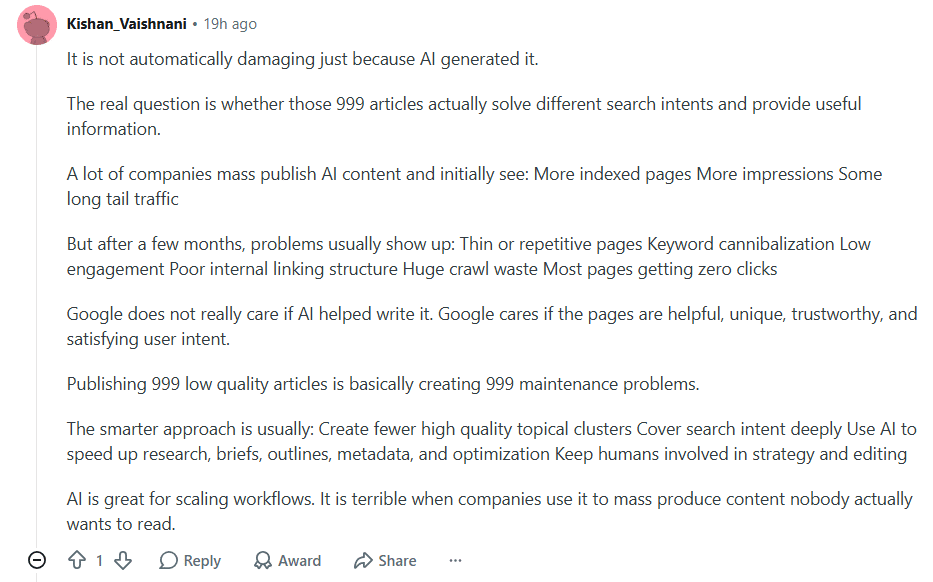
“Publishing 999 low quality articles is basically creating 999 maintenance problems.”
That may be the most useful way to look at it. Every new URL needs a purpose. It needs internal links. It needs to stay accurate. It needs to be refreshed when the topic changes. It needs to be strong enough that Google has a reason to keep it in the index.
If a site cannot maintain the pages it publishes, the content strategy can quickly turn into technical debt.
Google’s Own Words Keep Turning Up in This Debate
What gives this discussion weight is how closely it lines up with what Google has already written down.
The SEO Starter Guide keeps coming back to the same themes: useful content, original work and a people-first approach. It also states plainly that no secret technique guarantees a top ranking and that genuinely compelling content will do more for search performance than most technical maneuvers.
The helpful content guidance runs along the same track. Google asks publishers a direct question: is this content made for people, or made mainly to attract visits from search engines?
That question matters more now because AI has changed the economics of content. Producing 999 articles no longer requires the same time, budget or editorial effort it once did. But cheaper production does not make the pages more useful. It only makes weak pages easier to publish.
Read together, Google’s guidance lands close to the same conclusion the discussion kept circling back to:
Volume by itself is not a strategy.
What This Debate Actually Reveals
The more significant shift is economic.
For years, publishing at scale gave sites a competitive edge simply because production was expensive and slow. AI has collapsed that cost. Putting hundreds of pages live is no longer hard. Scale, as a result, is losing the differentiation it once had.
That puts operators in a difficult position. Every page added to a site brings new maintenance requirements, internal-linking obligations, quality-control demands, update responsibilities and indexing complexity.
The organizations that will actually get something out of AI-assisted publishing are the ones pairing automation with genuine subject-matter knowledge, editorial judgment, proprietary insight and a clear picture of who they are writing for. Those ingredients produce something automation cannot manufacture on its own.
The direction the industry is heading in is becoming harder to ignore. As content gets cheaper to produce, originality becomes worth more. As publishing gets easier, usefulness becomes the thing that separates good from forgettable.
The argument over 999 articles is, underneath everything, an argument about where SEO goes from here.
AI has made publishing easy. It has not made every page worth indexing.


