


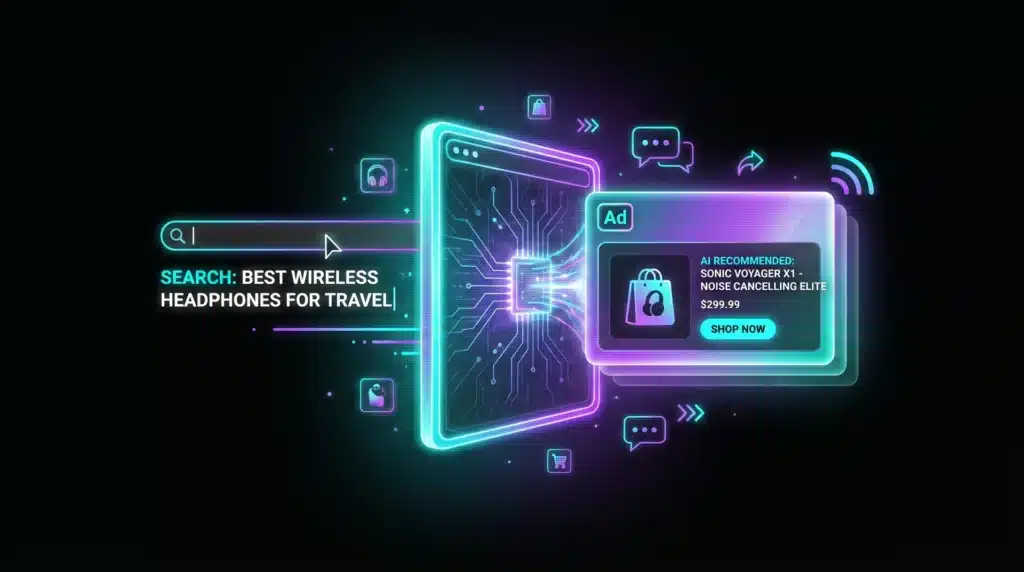
- Google is testing new AI-driven ad formats inside AI Mode, including Conversational Discovery ads, AI-powered Shopping ads and Business Agent for Leads.
- The shift moves Search advertising closer to product advice, AI-generated explanations and conversational lead capture, rather than classic keyword-based text ads.
Google is testing a new generation of Search ads built for AI Mode, where sponsored results can respond more directly to the user’s question instead of simply appearing as traditional paid links.
The company announced the updates around Google Marketing Live 2026, where it described new ad experiences powered by Gemini and designed for the way people now search, compare products and ask follow-up questions.
The most important formats include Conversational Discovery ads, Highlighted Answers, AI-powered Shopping ads and Business Agent for Leads. Together, they suggest a much bigger change in paid search: ads are moving from static placements toward AI-assisted answers, product recommendations and automated conversations.
Ads are becoming part of the AI answer
In classic Search, the ad is usually separated from the answer. A user searches, sees a sponsored link and decides whether to click.
AI Mode changes that flow. Google says Conversational Discovery ads can use Gemini to build ad experiences that respond to the user’s query and help guide discovery inside the AI search journey. Instead of only matching a keyword, the ad can become part of the conversation around what the user is trying to solve.
That matters because many commercial searches are not simple anymore. A shopper may not search for a single product name. They may ask for the best running shoes for flat feet, the right sofa for a small apartment or a software tool that fits a specific workflow.
With Gemini-powered ads, Google is trying to make paid results more useful in that kind of query. The ad does not just say, “Here is a product.” It can explain why a product, service or business may fit the user’s need.
AI-powered Shopping ads add product explanations
One of the clearest examples is AI-powered Shopping ads. Google says these ads can use Gemini to identify relevant products and add AI-generated explanations that show why a product matches the shopper’s query.
That turns Shopping ads into something closer to product advice. For advertisers, the product feed becomes even more important because Gemini needs structured, accurate and useful information to understand what the product is, who it is for and why it should appear for a specific search. It also connects to Google’s broader move toward AI-assisted advertising workflows, which we covered in our article on Google Ask Advisor.
This also connects with Google’s broader push into AI commerce. At Google Marketing Live, the company positioned AI as a way to reduce friction across discovery, comparison and conversion. That broader shift is also visible in how AI-referred shoppers are beginning to change ecommerce performance. Coverage from Search Engine Land described the event as a move toward a more conversational and AI-driven advertising, commerce and measurement ecosystem.
Business Agent for Leads brings automation into lead generation
Google is also bringing Business Agent for Leads into the mix. This points to another major direction for paid search: ads that do not only send users to a landing page, but help qualify intent and collect information through an AI-guided interaction.
For service businesses, this could become a meaningful shift. A user looking for a lawyer, contractor, dentist, local service provider or B2B vendor may not want to click through several pages. They may want quick answers, pricing direction, availability or a next step.
If Google can turn that interaction into a sponsored AI workflow, paid search becomes less about the landing page alone and more about how well the business can be represented inside Google’s AI interface.
This is not just another ad format
The bigger story is that Google is trying to monetize AI search without simply copying old Search ads into a new interface.
Ads inside AI Mode are likely to feel different because the user is not just scanning blue links. They are asking questions, comparing options and expecting a useful answer. That creates a new challenge for Google: ads have to be clearly sponsored, commercially useful and still trusted by users inside an AI-generated experience.
That makes the update part of a wider change in search visibility, where businesses are no longer only competing for clicks, but also for inclusion inside AI-generated answers. We have covered that broader shift in our analysis of whether AI search optimization is still just SEO.
The Wall Street Journal reported that Google is testing AI-generated ad formats in AI Mode and traditional Search, including conversational discovery ads, direct offers and sponsored answer-style placements. The report also noted the tension Google faces as it expands advertising into AI responses while trying to preserve user trust.
What advertisers should watch
For PPC teams, this makes campaign structure, product feeds, landing page clarity and business data more important. If Gemini is helping interpret user intent and generate ad explanations, weak or vague business information becomes a bigger disadvantage.
Advertisers may need to think less like they are only writing ads and more like they are training Google’s system to understand their products, offers, use cases and customer fit.
That means clean Merchant Center data, strong product attributes, useful landing pages, clear service descriptions and reliable conversion tracking could become even more central to paid search performance.
The Query Post view
This is one of the more important PPC shifts to watch because it changes what a Search ad is.
For years, paid search was built around matching intent with a keyword, an ad and a landing page. AI Mode starts to blur that structure. The ad can become part of the answer. The product listing can come with an AI-generated explanation. The lead form can become a conversation.
That does not mean classic PPC disappears. But it does mean advertisers may have less control over the exact final wording users see and more pressure to feed Google with clean, structured and trustworthy business information.
The winners will probably not be the advertisers with the cleverest headline alone. They will be the ones whose products, offers and data are easiest for Google’s AI systems to understand and recommend.


